

[Aug 12, 2026] Valid 100-150 Test Answers & Cisco 100-150 Exam PDF
Realistic 100-150 Exam Dumps with Accurate & Updated Questions
NEW QUESTION # 31
Drag and Drop Question
Examine the connections shown in the following image. Move the cable types on the right to the appropriate connection description on the left. You may use each cable type more than once or not at all.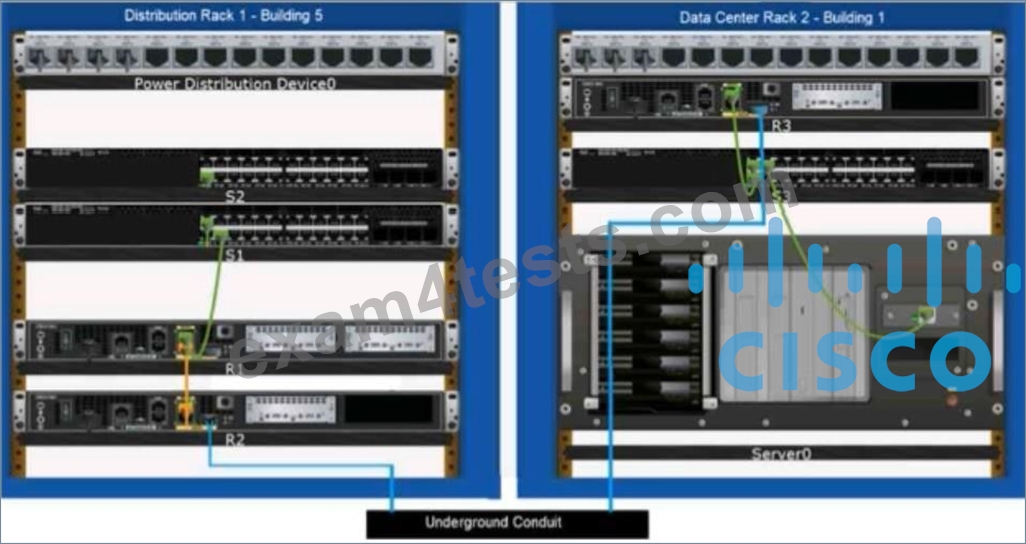
Note: You will receive partial credit for each correct response.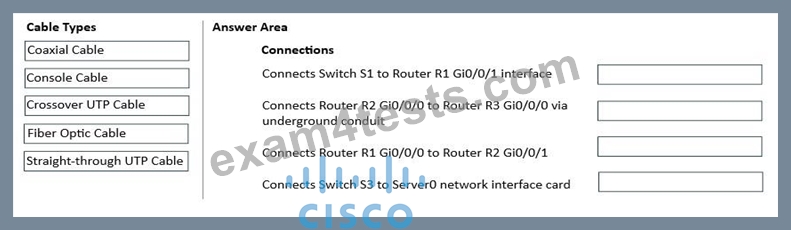
Answer:
Explanation: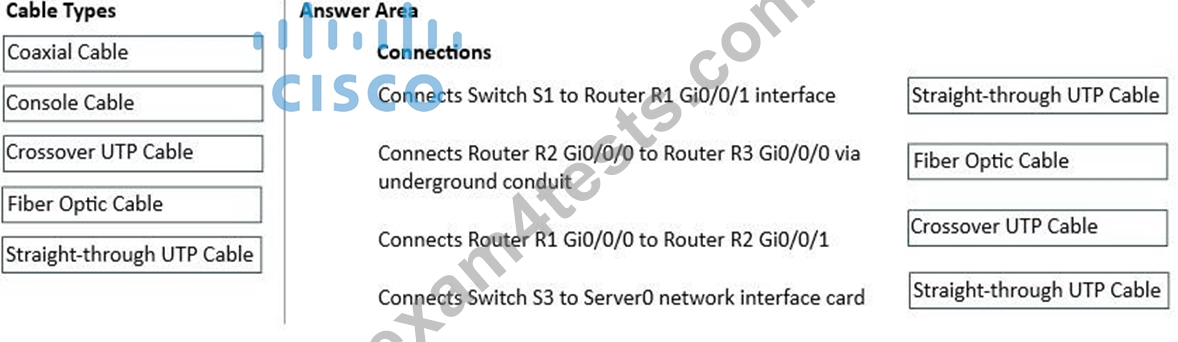
NEW QUESTION # 32
Which standard contains the specifications for Wi-Fi networks?
- A. IEEE 802.11
- B. LTE
- C. GSM
- D. EIA/TIA 568A
- E. IEEE 802.3
Answer: A
Explanation:
IEEE 802.11 is the standard that defines the protocols and specifications for wireless local area (Wi-Fi) networking.
NEW QUESTION # 33
HOTSPOT
You purchase a new Cisco switch, turn it on, and connect to its console port. You then run the following command: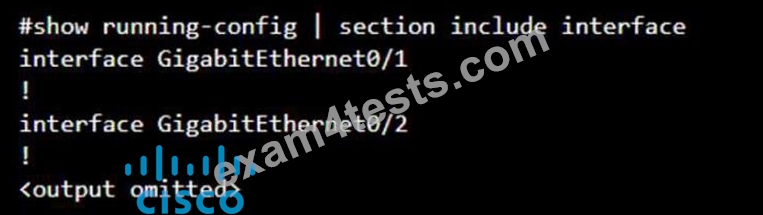
For each statement about the output, select True or False. Note: You will receive partial credit for each correct selection.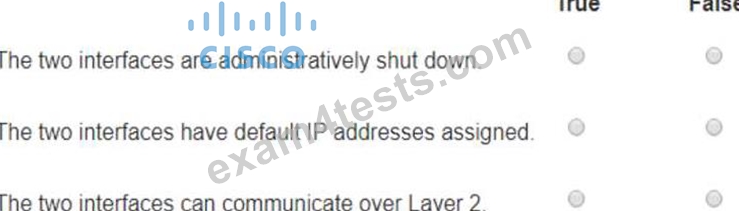
Answer:
Explanation: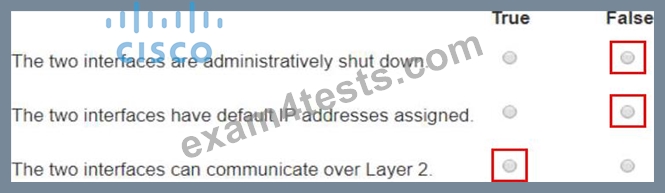
Explanation:
The two interfaces are administratively shut down:
False: The output does not show any "shutdown" command under the interfaces, which would indicate that they are administratively shut down. Therefore, they are likely in their default state, which is administratively up.
The two interfaces have default IP addresses assigned:
False: The output does not show any IP address configuration. In the default state, interfaces do not have IP addresses assigned unless explicitly configured.
The two interfaces can communicate over Layer 2:
True: By default, interfaces on a switch are Layer 2 interfaces capable of forwarding Ethernet frames. As there is no configuration provided that changes this, it can be assumed they can communicate over Layer 2.
Interface Status: The absence of the "shutdown" command means the interfaces are not administratively shut down.
IP Address Assignment: There is no evidence in the output that IP addresses have been assigned to the interfaces, which would typically be shown as "ip address" entries.
Layer 2 Communication: Switch interfaces in their default state operate at Layer 2, enabling them to forward Ethernet frames and participate in Layer 2 communication.
Reference: Cisco IOS Interface Configuration: Cisco Interface Configuration
Understanding Cisco Switch Interfaces: Cisco Switch Interfaces
NEW QUESTION # 34
During the data encapsulation process, which OSI layer adds a header that contains MAC addressing information and a trailer used for error checking?
- A. Network
- B. Transport
- C. Session
- D. Data Link
Answer: D
Explanation:
During the data encapsulation process, the Data Link layer of the OSI model is responsible for adding a header that contains MAC addressing information and a trailer used for error checking. The header typically includes the source and destination MAC addresses, while the trailer contains a Frame Check Sequence (FCS) which is used for error detection1.
The Data Link layer ensures that messages are delivered to the proper device on a LAN using hardware addresses and translates messages from the Network layer into bits for the Physical layer to transmit. It also controls how data is placed onto the medium and is received from the medium through the physical hardware.
Reference: =
The OSI Model - The 7 Layers of Networking Explained in Plain English
OSI Model - Network Direction
Which layer adds both header and trailer to the data?
What is OSI Model | 7 Layers Explained - GeeksforGeeks
NEW QUESTION # 35
A user initiates a trouble ticket stating that an external web page is not loading. You determine that other resources both internal and external are still reachable.
Which command can you use to help locate where the issue is in the network path to the external web page?
- A. ping -t
- B. ipconfig/all
- C. nslookup
- D. tracert
Answer: D
Explanation:
The tracert command is used to determine the route taken by packets across an IP network. When a user reports that an external web page is not loading, while other resources are accessible, it suggests there might be an issue at a certain point in the network path to the specific web page. The tracert command helps to diagnose where the breakdown occurs by displaying a list of routers that the packets pass through on their way to the destination. It can identify the network segment where the packets stop progressing, which is valuable for pinpointing where the connectivity issue lies.
Reference: =
Cisco CCST Networking Certification FAQs - CISCONET Training Solutions, Command Prompt (CMD): 10 network-related commands you should know, Network Troubleshooting Commands Guide: Windows, Mac & Linux - Comparitech, How to Use the Traceroute and Ping Commands to Troubleshoot Network, Network Troubleshooting Techniques: Ping, Traceroute, PathPing.
* tracert Command: This command is used to determine the path packets take to reach a destination. It lists all the hops (routers) along the way and can help identify where the delay or
failure occurs.
* ping -t: This command sends continuous ping requests and is useful for determining if a host is reachable but does not provide path information.
* ipconfig /all: This command displays all current TCP/IP network configuration values and can be used to verify network settings but not to trace a network path.
* nslookup: This command queries the DNS to obtain domain name or IP address mapping, useful for DNS issues but not for tracing network paths.
Reference:
* Microsoft tracert Command: tracert Command Guide
* Troubleshooting Network Issues with tracert: Network Troubleshooting Guide
NEW QUESTION # 36
What is the most compressed valid format of the IPv6 address 2001:0db8:0000:0016:0000:001b:2000:0056?
- A. 2001:db8::16::1b:2:56
- B. 2001:db8:16::1b:2:56
- C. 2001:db8:0:16::1b:2000:56
- D. 2001:db8::16::1b:2000:56
Answer: C
Explanation:
Removing leading zeros yields 2001:db8:0:16:0:1b:2000:56, and collapsing the longest zero run (the fifth hextet) produces 2001:db8:0:16::1b:2000:56.
NEW QUESTION # 37
You want to list the IPv4 addresses associated with the host name www.companypro.net.
Complete the command by selecting the correct option from each drop-down list.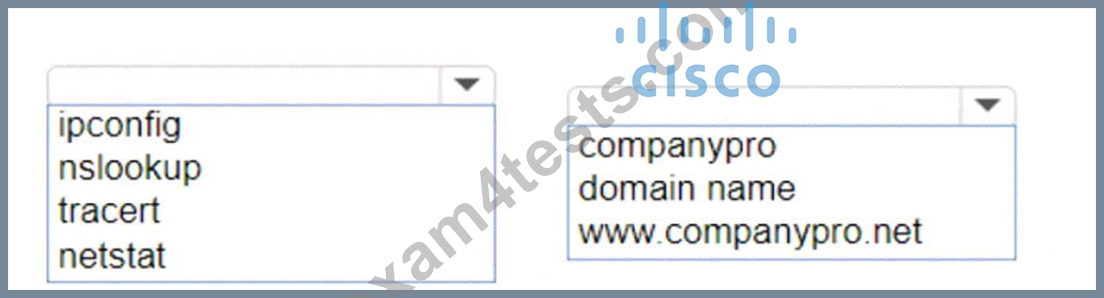
Answer:
Explanation: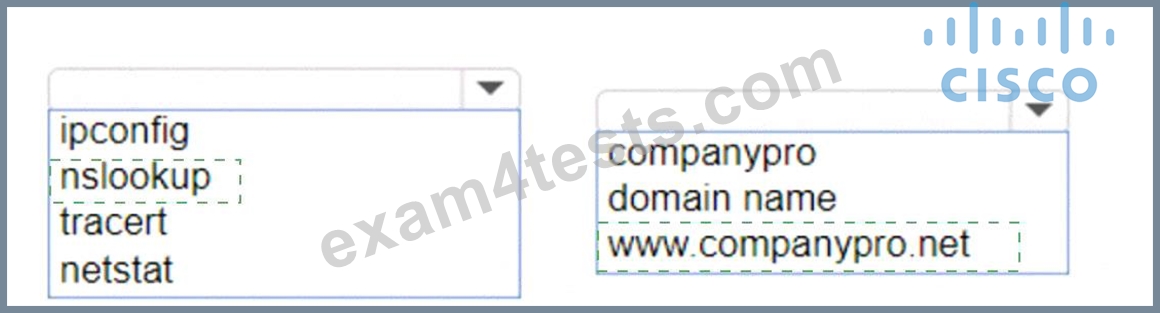
Explanation:
To list the IPv4 addresses associated with the host name www.companypro.net, you should use the following command:
nslookup www.companypro.net
This command will query the DNS servers to find the IP address associated with the hostname provided. If you want to ensure that it returns the IPv4 address, you can specify the -type=A option, which stands for Address records that hold IPv4 addresses1. However, the nslookup command by default should return the IPv4 address if available.
To list the IPv4 addresses associated with the host name www.companypro.net, you should use the nslookup command.
* Command: nslookup
* Target: www.companypro.net
So, the completed command is:
* nslookup www.companypro.net
* nslookup: This command is used to query the Domain Name System (DNS) to obtain domain name or IP address mapping or for any other specific DNS record.
* www.companypro.net: This is the domain name you want to query to obtain its associated IP addresses.
References:
* Using nslookup: nslookup Command Guide
NEW QUESTION # 38
A user at your company cannot connect to websites on the internet. However, they can connect to network resources on the company LAN.
You want to use the divide-and-conquer approach to troubleshoot the issue.
What should you do first?
- A. Ping the default gateway from the user's computer.
- B. Run the Telnet command from the user's computer.
- C. Check the computer's cable connections.
- D. Check the computer's network adapter.
Answer: A
Explanation:
The divide-and-conquer method starts testing in the middle of the stack to quickly narrow the problem. Pinging the default gateway checks whether the user can reach beyond the local host to the local network boundary. Since the user can access LAN resources but not internet websites, this is the best first step to determine whether the issue is on the local side or farther upstream.
NEW QUESTION # 39
When setting up a wireless network, which security benefit is provided by enabling WPA3?
- A. Sends traffic through an encrypted tunnel
- B. Makes it more difficult to discover the wireless network
- C. Secures authentication between client and access point
- D. Limits network access to only specified devices
Answer: C
Explanation:
WPA3 strengthens the authentication process between the wireless client and the access point and improves protection for wireless sessions. Its main security benefit is more secure authentication when devices connect to the Wi-Fi network.
NEW QUESTION # 40
Evaluate the graphic.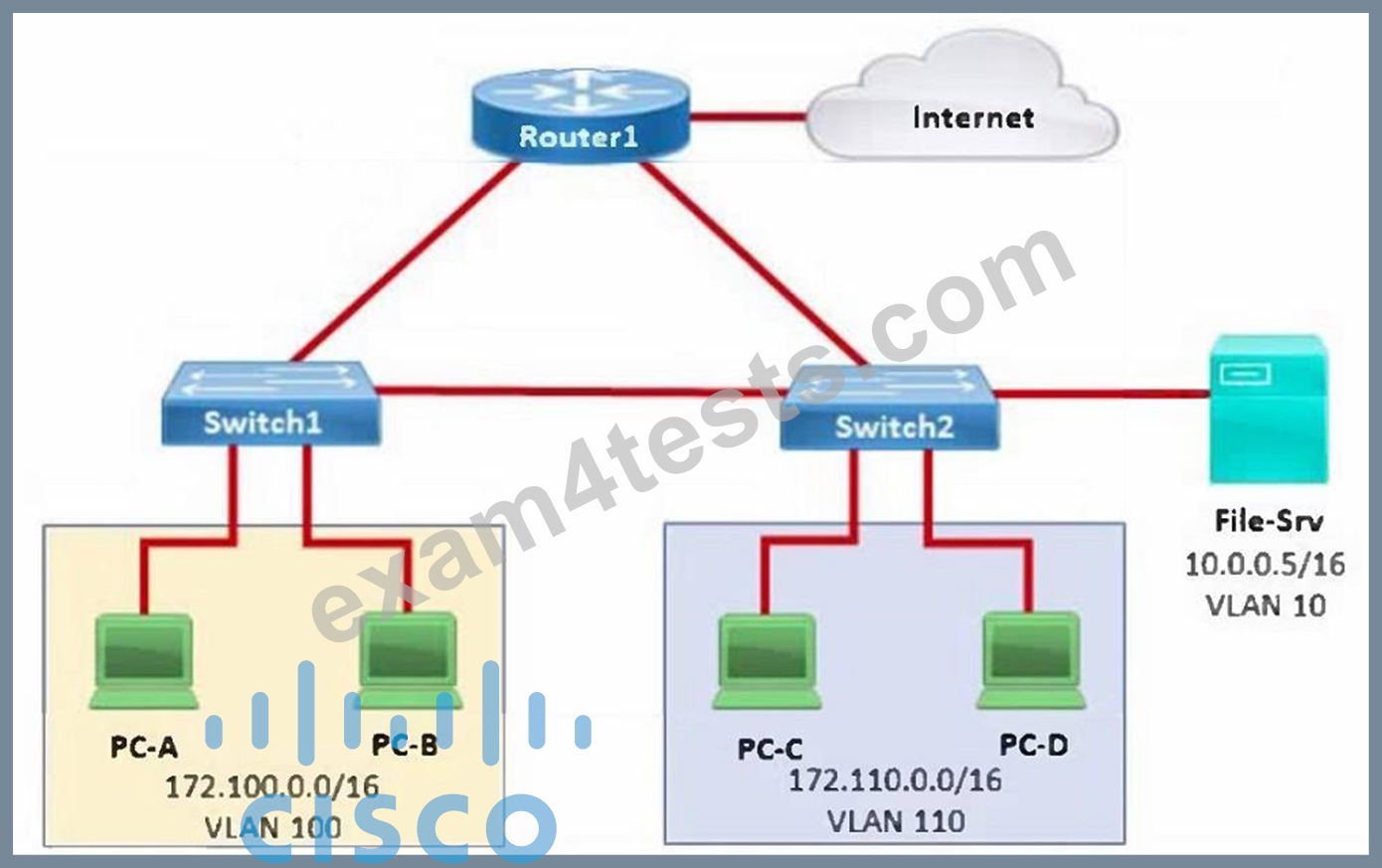
While making a configuration change to Router1, a junior technician accidentally reboots the router.
Which two statements are true about the impact to communication on the network while the router is temporarily offline? (Choose two.)
- A. None of the PCs can access the file server (File-Srv).
- B. PC-A, PC-B, PC-C, and PC-D can all still communicate with each other.
- C. PC-C and PC-D can still communicate with the file server (File-Srv).
- D. The file server (File-Srv) can still access the Internet.
- E. PC-A and PC-B can still communicate with each other.
Answer: A,E
Explanation:
Communication between different VLANs requires Router1, so without the router, no PC can reach the file server in VLAN 10. Devices in the same VLAN can still communicate at Layer 2 through the switch, so PC-A and PC-B can still communicate with each other.
NEW QUESTION # 41
Which two statements are true about the IPv4 address of the default gateway configured on a host? (Choose 2.) Note: You will receive partial credit for each correct selection.
- A. Hosts learn the default gateway IPv4 address through router advertisement messages.
- B. The default gateway is the IPv4 address of the router interface connected to the same local network as the host.
- C. The default gateway is the Loopback0 interface IPv4 address of the router connected to the same local network as the host.
- D. The IPv4 address of the default gateway must be the first host address in the subnet.
- E. The same default gateway IPv4 address is configured on each host on the local network.
Answer: B,E
Explanation:
*Statement B: "The same default gateway IPv4 address is configured on each host on the local network." This is true because all hosts on the same local network (subnet) use the same default gateway IP address to send packets destined for other networks.
*Statement D: "The default gateway is the IPv4 address of the router interface connected to the same local network as the host." This is true because the default gateway is the IP address of the router's interface that is directly connected to the local network.
*Statement A: "The IPv4 address of the default gateway must be the first host address in the subnet." This is not necessarily true. The default gateway can be any address within the subnet range.
*Statement C: "The default gateway is the Loopback0 interface IPv4 address of the router connected to the same local network as the host." This is not true; the default gateway is the IP address of the router's physical or logical interface connected to the local network.
*Statement E: "Hosts learn the default gateway IPv4 address through router advertisement messages." This is generally true for IPv6 with Router Advertisement (RA) messages, but not typically how IPv4 hosts learn the default gateway address.
References:
*Cisco Default Gateway Configuration: Cisco Default Gateway
NEW QUESTION # 42
A help desk technician receives the four trouble tickets listed below. Which ticket should receive the highest priority and be addressed first?
- A. Ticket 1: A user requests relocation of a printer to a different network jack in the same office. The jack must be patched and made active.
- B. Ticket 2: An online webinar is taking place in the conference room. The video conferencing equipment lost internet access.
- C. Ticket 4: Two users report that wireless access in the cafeteria has been down for the last hour.
- D. Ticket 3: A user reports that response time for a cloud-based application is slower than usual.
Answer: B
Explanation:
An ongoing webinar is a time-sensitive business event; restoring its connectivity immediately minimizes organizational impact.
NEW QUESTION # 43
Which protocol provides reliable, connection-oriented communication with error checking and retransmission capabilities?
- A. IP
- B. ARP
- C. TCP
- D. UDP
Answer: C
Explanation:
TCP ensures reliable communication by establishing connections, sequencing data, acknowledging receipt, and retransmitting lost packets, making it suitable for applications requiring accuracy.
NEW QUESTION # 44
A user reports that a company website is not available. The help desk technician issues a tracert command to determine if the server hosting the website is reachable over the network. The output of the command is shown as follows: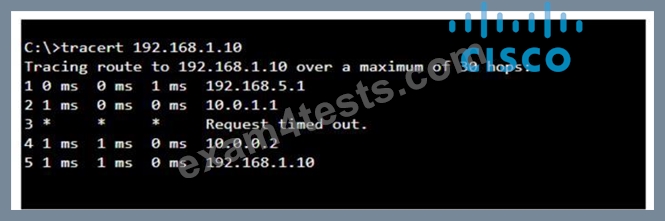
What can you tell from the command output?
- A. Requests to the web server at 192.168.1.10 are being delayed and time out.
- B. The server with the address 192.168.1.10 is reachable over the network.
- C. The router at hop 3 is not forwarding packets to the IP address 192.168.1.10.
- D. The server address 192.168.1.10 is being blocked by a firewall on the router at hop 3.
Answer: B
Explanation:
The tracert command output shows the path taken to reach the destination IP address, 192.168.1.10. The command output indicates:
*Hops 1 and 2 are successfully reached.
*Hop 3 times out, meaning the router at hop 3 did not respond to the tracert request. However, this does not necessarily indicate a problem with forwarding packets, as some routers may be configured to block or not respond to ICMP requests.
*Hops 4 and 5 are successfully reached, with hop 5 being the destination IP 192.168.1.10, indicating that the server is reachable.
Thus, the correct answer is C. The server with the address 192.168.1.10 is reachable over the network.
References :=
*Cisco Traceroute Command
*Understanding Traceroute
The tracert command output indicates that the server with the address 192.168.1.10 is reachable over the network. The asterisk (*) at hop 3 suggests that the probe sent to that hop did not return a response, which could be due to a variety of reasons such as a firewall blocking ICMP packets or the router at that hop being configured not to respond to ICMP requests. However, since the subsequent hops (4 and 5) are showing response times, it means that the packets are indeed getting through and the server is reachable12.
References :=
*How to Use Traceroute Command to Read Its Results
*How to Use the Tracert Command in Windows
NEW QUESTION # 45
Move each protocol from the list on the left to the correct TCP/IP model layer on the right.
Note: You will receive partial credit for each correct match.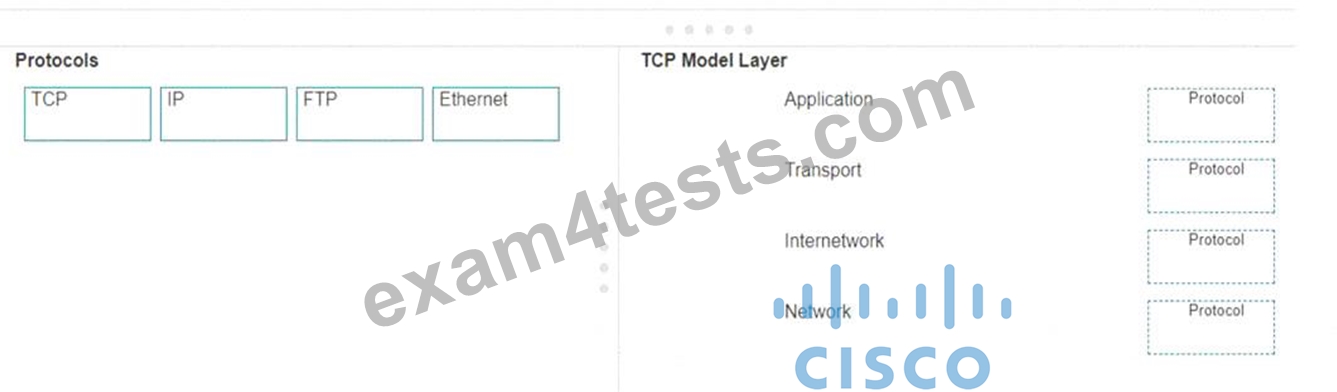
Answer:
Explanation: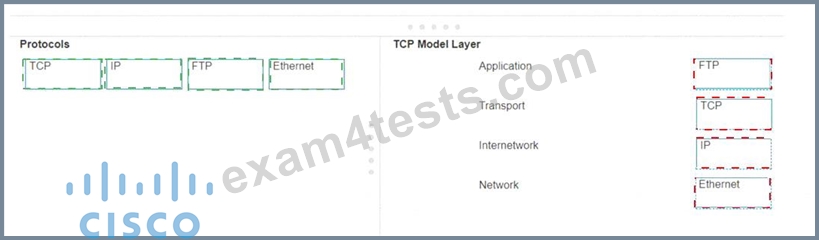
Explanation:
Here's how each protocol aligns with the correct TCP/IP model layer:
* TCP (Transmission Control Protocol): This protocol belongs to the Transport layer, which is responsible for providing communication between applications on different hosts1.
* IP (Internet Protocol): IP is part of the Internetwork layer, which is tasked with routing packets across network boundaries to their destination1.
* FTP (File Transfer Protocol): FTP operates at the Application layer, which supports application and end- user processes. It is used for transferring files over the network1.
* Ethernet: While not a protocol within the TCP/IP stack, Ethernet is associated with the Network Interface layer, which corresponds to the link layer of the TCP/IP model and is responsible for the physical transmission of data1.
The TCP/IP model layers are designed to work collaboratively to transmit data from one layer to another, with each layer having specific protocols that perform functions necessary for the data transmission process1.
* TCP:
* TCP Model Layer: Transport
* Explanation: The Transport layer is responsible for end-to-end communication and error handling. TCP (Transmission Control Protocol) operates at this layer to provide reliable, ordered, and error-checked delivery of data.
* IP:
* TCP Model Layer: Internetwork
* Explanation: The Internetwork layer, also known as the Internet layer, is responsible for logical addressing and routing. IP (Internet Protocol) operates at this layer to route packets across networks.
* FTP:
* TCP Model Layer: Application
* Explanation: The Application layer provides network services to applications. FTP (File Transfer Protocol) operates at this layer to transfer files between computers over a network.
* Ethernet:
* TCP Model Layer: Network
* Explanation: The Network layer, also known as the Link layer in the TCP/IP model, is responsible for physical addressing and access to the physical medium. Ethernet operates at this layer to provide the physical and data link functions.
* Transport Layer: This layer is responsible for providing communication services directly to the application processes running on different hosts. TCP is a core protocol in this layer.
* Internetwork Layer: This layer is responsible for logical addressing, routing, and packet forwarding.
IP is the primary protocol for this layer.
* Application Layer: This layer interfaces directly with application processes and provides common network services. FTP is an example of a protocol operating in this layer.
* Network Layer: In the TCP/IP model, this layer includes both the data link and physical layers of the OSI model. Ethernet is a protocol used in this layer to define network standards and communication protocols at the data link and physical levels.
References:
* TCP/IP Model Overview: Cisco TCP/IP Model
* Understanding the TCP/IP Model: TCP/IP Layers
NEW QUESTION # 46
Which two pieces of information should you include when you initially create a support ticket?
(Choose two.)
- A. A description of the conditions when the fault occurs
- B. A detailed description of the fault
- C. Details about the computers connected to the network
- D. The description of the top-down fault-finding procedure
- E. The actions taken to resolve the fault
Answer: A,B
Explanation:
Describing the conditions when the fault occurs helps reproduced and scope the issue.
A detailed description of the fault gives clear context and symptoms for triage.
NEW QUESTION # 47
......
100-150 Exam Dumps - PDF Questions and Testing Engine: https://exam-labs.exam4tests.com/100-150-pdf-braindumps.html