

The Ultimate Pegasystems PEGACPDC25V1 Dumps PDF Review
Achieve The Utmost Performance In PEGACPDC25V1 Exam Pass Guaranteed
NEW QUESTION # 39
MyCo, a mobile company, uses Pega Customer Decision Hub to display offers to customers on its website.
The company wants to present more relevant offers to customers based on customer behavior. The following diagram is the action hierarchy in the Next-Best-Action Designer.
The company wants to present offers from both the groups and arbitrate across the two groups to select the best offer based on customer behavior.
The company wants to present offers from both the groups and arbitrate across the two groups to select the best offer based on customer behavior.
As a decisioning architect, what do you configure to select the best offer from both groups based on customer behavior?
- A. Enable a business value in the prioritization formula.
- B. Create a prioritization decision strategy at the Group-level.
- C. Create an adaptive model rule at the Issue-level.
- D. Ensure that the propensity is enabled in Arbitration tab.
Answer: D
Explanation:
To select the best offer from both groups based on customer behavior, you need to ensure that the propensity is enabled in Arbitration tab. Propensity is a measure of how likely a customer is to accept an offer, based on their past behavior and profile. By enabling propensity in Arbitration tab, you can compare the propensities of different offers across groups and select the one with the highest propensity as the next best action. Verified References: Pega Academy - Decisioning Consultant - Arbitrating actions
NEW QUESTION # 40
In a decision strategy, you can use aggregation components to____________.
- A. choose between actions
- B. set a text value to a strategy property
- C. make calculations based upon a list of actions
- D. filter actions based on priority and relevance
Answer: C
Explanation:
Aggregation components are used to perform calculations on a list of actions, such as sum, average, count, minimum, or maximum. For example, you can use an aggregation component to calculate the total value of all the actions in a group. Verified Reference: Pega Academy - Decisioning Consultant - Aggregating actions
NEW QUESTION # 41
In the Impact Analyzer tool, what does It mean when the overall health Indicator of the next best action has a red highlight?
- A. The next best action Is performing exceptionally well.
- B. The experiment has insufficient data.
- C. The next best action needs further optimization.
- D. The tool is not functioning properly.
Answer: C
NEW QUESTION # 42
MyCo, a mobile company, uses Pega Customer Decision Hub to display offers to customers on its website. The company wants to present more relevant offers to customers based on customer behavior. The following diagram is the action hierarchy in the Next-Best-Action Designer.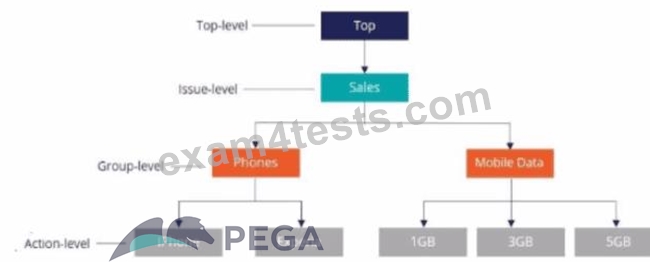
The company wants to present offers from both the groups and arbitrate across the two groups to select the best offer based on customer behavior.
As a decisioning architect, what must you do to present offers from the two groups?
- A. Set contact limits for both the groups.
- B. Map a real-time container to the Top-level or Issue-level.
- C. Create a decision strategy at the Issue-level
- D. Enable an engagement policy for the second group.
Answer: B
Explanation:
To present offers from the two groups, you must map a real-time container to the Top-level or Issue-level. A real-time container is a configuration that defines how to deliver offers and treatments to a specific channel, such as a website or a mobile app. By mapping a real-time container to the Top-level or Issue-level, you can enable all the offers under that level to be available for delivery through that channel. Verified Reference: Pega Academy - Decisioning Consultant - Configuring real-time containers
NEW QUESTION # 43
MyCo, a telecom company, uses Pega Customer Decision Hub to present offers to qualified customers. The business recently decided to send offer messages through the email channel. The Design department has designed an email treatment which includes dynamic placeholders.
As a deaccessioning architect, what do you use in order to test the visualization and the rendering of the email content, including replacing of the placeholders with customer information?
- A. A list of customer email addresses from the Test email tab
- B. A seed list from the Test email tab
- C. Schedule an outbound run with a limited number of customers
- D. Preview section from the email content editor
Answer: B
Explanation:
To test the visualization and the rendering of the email content, including replacing of the placeholders with customer information, you use a seed list from the Test email tab. A seed list is a predefined set of customers that you can use to test your email treatments before sending them to your target audience. You can select one or more customers from the seed list and send them a test email with your treatment. You can then verify how the email looks in their inbox and how the placeholders are replaced with their actual values. Verified References: [Pega Academy - Decisioning Consultant - Testing email treatments]
NEW QUESTION # 44
U+ Bank, a retail bank, uses the Business Operations Environment to perform its business changes. The bank carries out these changes in the Pega Customer Decision Hub portal by using revision management features or the 1:1 Operations Manager portal.
For each task, select the correct portal in which you initiate the change request based on best practices.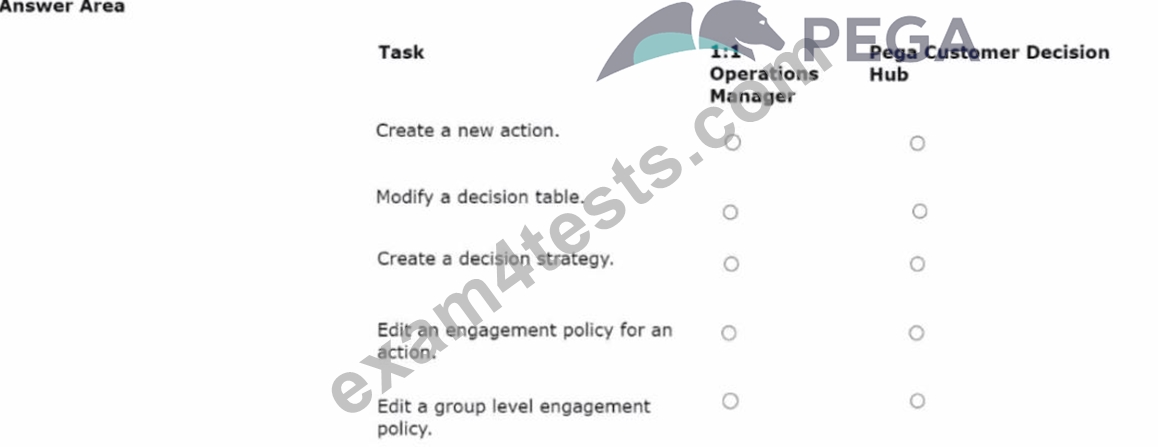
Answer:
Explanation: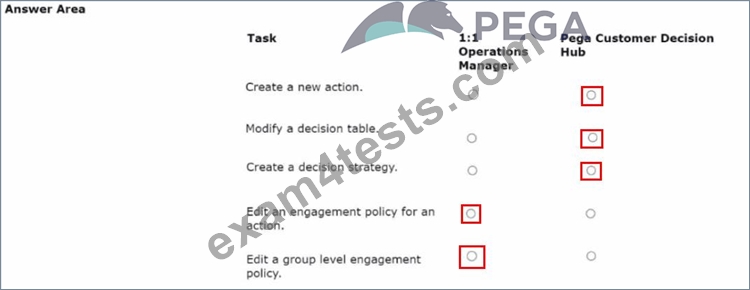
NEW QUESTION # 45
U+ Bank uses the always-on outbound approach to send outbound messages on different channels such as email. SMS, and push notifications. There are a variety of action flow patterns in use to meet various business and channel integrations requirements.
Due to technical reasons, the bank wants to temporarily suspend sending outbound messages and Instead write the selected customers and action details to a database table for later offline processing.
What is the most efficient way to meet this requirement?
- A. Add a new Send shape in all the action flows.
- B. Set up a secondary schedule.
- C. Update the Send shape with Finalization.
- D. Bypass action flow processing.
Answer: D
NEW QUESTION # 46
What does a dotted line from a "Group By" component to a "Filter" component mean?
- A. There is a one-to-one relationship between the "Group By" and the "Filter" components.
- B. Information from the "Group By" is copied over to the "Filter" component.
- C. To evaluate the "Group By" component, the "Filter" component is evaluated first.
- D. A property from the "Group By" is referenced by the "Filter" component.
Answer: D
Explanation:
A dotted line from a "Group By" component to a "Filter" component means that a property from the "Group By" is referenced by the "Filter" component. For example, if you group customers by age and then filter them by average spending, you need to reference a property from the "Group By" component, such as .pxSegment, in the "Filter" component. A dotted line does not indicate a one-to-one relationship, an evaluation order, or a copying of information between components
NEW QUESTION # 47
As a Customer Service Representative, you present an offer to a customer who called to learn more about a new product. The customer rejects the offer. What is the next step that Pega Customer Decision Hub takes?
- A. Reevaluates the Next-Best-Action
- B. Adds the customer to the potential churn list
- C. Stops presenting offers to the customer
- D. Sends a detailed email about the offer
Answer: A
Explanation:
Pega Customer Decision Hub is a dynamic and adaptive system that constantly reevaluates the Next-Best- Action for each customer based on their interactions and feedback. If a customer rejects an offer, the system will update the customer profile and the offer performance, and then reapply the Next-Best-Action strategy to select and prioritize another offer that is more relevant and valuable for the customer. Verified References:
[Pega Decisioning Consultant | Pega Academy]
NEW QUESTION # 48
U+ Bank, a retail bank, uses the Business Operations Environment to perform business changes. The team members of the Business Content team and Enterprise Capabilities team perform several roles in the change management process.
Select each role on the left and drag it to the task descriptions to which the role corresponds on the right.
Answer:
Explanation:
A close-up of a task AI-generated content may be incorrect.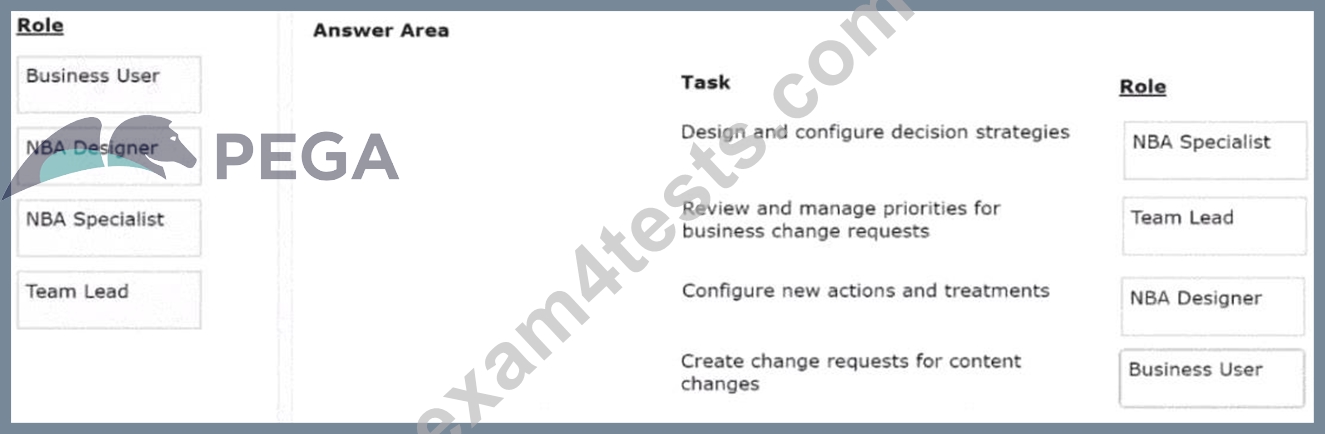
NEW QUESTION # 49
A financial institution has created a new policy that states the company will not send more than 500 emails per day. Which option allows you to implement the requirement?
- A. Applicability rules
- B. Volume constraints
- C. Suppression rules
- D. Outbound channel limits
Answer: B
Explanation:
Volume constraints allow you to limit the number of times an action is presented to customers across one or more channels. You can use volume constraints to implement a policy that restricts the number of emails sent per day. Outbound channel limits are used to limit the number of customers contacted per channel per run, not per day. Suppression rules are used to exclude customers from receiving an action based on certain conditions, such as opt-out preferences or recent purchases. Applicability rules are used to determine whether an action is relevant for a customer based on their profile or context, not based on the number of times the action is presented. Verified Reference: Certified Pega Decisioning Consultant | Pega Academy, Volume constraints
NEW QUESTION # 50
A financial institution's NBA team discovers that they need to modify their risk assessment strategy and edit a scorecard used for loan approvals. The team lead reviews the available options in 1:1 Operations Manager to determine the most appropriate approach to implementing these changes.
Which approach should the team lead use to implement these strategy and scorecard modifications?
- A. Submit an Update existing action request in 1:1 Operations Manager
- B. Create a new revision in 1:1 Operations Manager, followed by a new change request in the Customer Decision Hub portal
- C. Submit a Create new action request in 1:1 Operations Manager
- D. Submit an Other request type in the Customer Decision Hub portal
Answer: D
NEW QUESTION # 51
U+- Bank uses Pega Customer Decision Hub'" for their one-to-one customer engagement. The bank now wants to change its offer prioritization to consider both business objectives and customer needs.
Which two factors do you configure in the Next-Best-Action Designer to implement this change? (Choose Two)
- A. Contact policies
- B. Business levers
- C. Engagement policies
- D. Context weighting
Answer: B,D
NEW QUESTION # 52
U+ Bank, a retail bank, uses the business operations environment to perform its business changes. The bank completes these changes by using revision management features of Pega Customer Decision Hub and 1:1 Operations Manager.
Customers see credit card offers based on various engagement policies on the U+ Bank website. The bank wants to update the underlying decision strategy of an engagement policy condition.
According to best practices, which statement correctly describes the implementation of the change to fulfill this business requirement?
- A. A next-best-action specialist modifies the decision strategy in 1:1 Operations Manager.
- B. A next-best-action specialist modifies the decision strategy in Customer Decision Hub.
- C. A next-best-action designer modifies the decision strategy in Customer Decision Hub.
- D. A next-best-action designer modifies the decision strategy in 1:1 Operations Manager.
Answer: C
Explanation:
According to the best practice, a next-best-action designer should modify the decision strategy in Customer Decision Hub, because the decision strategy is part of the next-best-action framework that defines how to select and prioritize propositions for each customer. The 1:1 Operations Manager portal is used to manage the engagement policies and propositions, not the decision strategies. Verified References: Pega Decisioning Consultant | Pega Academy
NEW QUESTION # 53
U+ Bank uses a scorecard rule in a decision strategy to compute the mortgage limit for a customer. U+ Bank updated their scorecard to include a new property in the calculation: customer income.
What changes do you need to make in the decision strategy for the updated scorecard to take effect?
- A. Add a new Group By component for the mortgage limit calculation.
- B. Remap the scorecard property in the decision strategy for the change to take effect.
- C. The score calculation is independent of the strategy and no change is required.
- D. A new proposition filter needs to be configured in the strategy to filter on customer income.
Answer: C
Explanation:
The score calculation is independent of the strategy and no change is required. When you use a scorecard component in a decision strategy, you only need to specify the name of the scorecard rule and the output property that will store the score value. The scorecard rule itself defines how the score is calculated based on the input properties and factors. Therefore, if you update the scorecard rule to include a new property in the calculation, you do not need to make any changes in the decision strategy for the updated scorecard to take effect. Verified Reference: [Pega Academy - Decisioning Consultant - Using scorecards]
NEW QUESTION # 54
The U+ Bank marketing department wants to leverage the next-best-action capability of Pega Customer Decision Hub on Its website to promote new offers to each customer.
Place the events in the sequential order.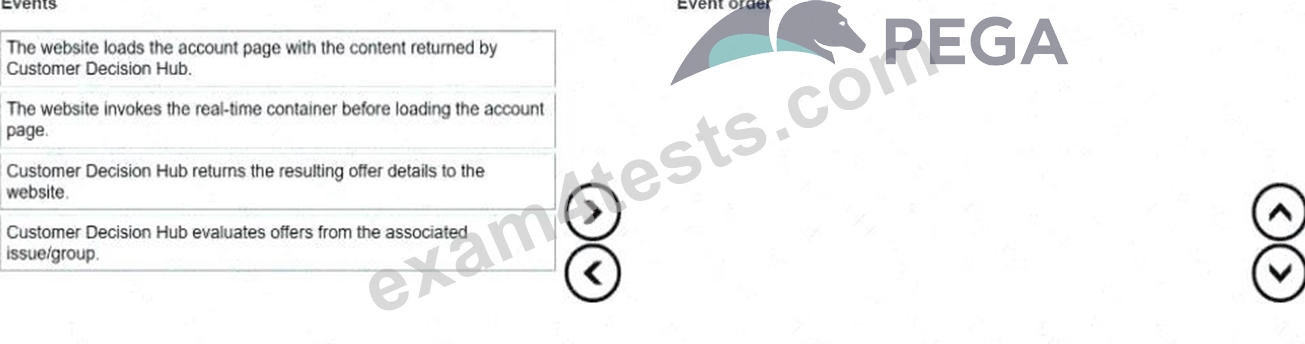
Answer:
Explanation: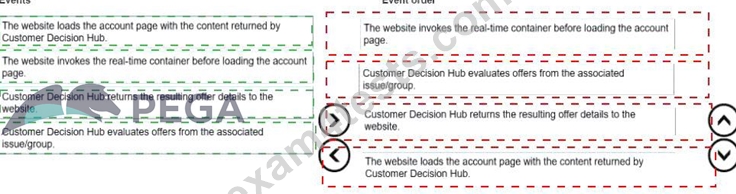
Explanation: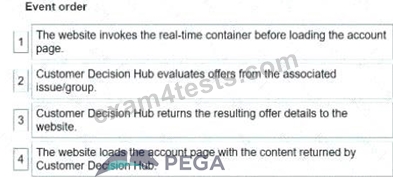
NEW QUESTION # 55
A revision manager needs to deploy changes from the business operations environment to production. The NBA Specialist has completed all build tasks and validated the generated artifacts. The team lead has promoted the change request to the revision manager for deployment processing.
Which step should you take to push the changes to production?
- A. Return the change request to the NBA Specialist for integration testing
- B. Create a new change request to specifically address the deployment step
- C. Deploy the change request to production before closing It in 1:1 Operations Manager
- D. Access Revision Management in Pega Customer Decision Hub portal, review the change request, and push to deployment
Answer: D
NEW QUESTION # 56
In the following figure, a volume constraint uses the Return any action that does not exceed constraint mode with the three following action type constraints that have remaining limits:
1.Maximum 50 Daily with Action: Protect Your Device, 5 remaining
2.Maximum 75 Daily with Action: MyFone Buds, 7 remaining
3.Maximum 25 Daily with Action: MyFone AirPods Pro, 0 remaining
A customer, CUST-01, qualifies for all the three actions. Given this scenario, how many actions does the system select for CUST-01 in the outbound run?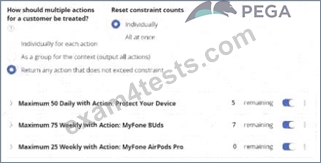
- A. 0
- B. 1
- C. 2
- D. 3
Answer: C
NEW QUESTION # 57
As a decisioning architect, how can you optimize the strategies that are based on Insights that you gain from the AI Insight feature in the Customer Profile Viewer?
- A. By understanding how action performance is used and why new actions are required
- B. By understanding how engagement policies are being used and why certain actions are filtered
- C. By integrating social media analytics into the Customer Profile Viewer
- D. By generating automated marketing campaigns based on customer data
Answer: B
NEW QUESTION # 58
To access a property from an unconnected component, you use the
- A. customer-dot-property construct
- B. component-dot-property construct
- C. dot-property value directly
- D. property value
Answer: B
Explanation:
To access a property from an unconnected component, you use the component-dot-property construct. For example, if you want to access the property .Rank from an unconnected component named ActionRanking, you use ActionRanking.Rank. Verified Reference: Pega Academy - Decisioning Consultant - Accessing properties from unconnected components
NEW QUESTION # 59
U+ Bank wants to use Pega Customer Decision Hub"* to display a credit card offer, the Standard Card, to every customer who logs in to the bank website.
What three of the following artifacts are mandatory to implement this requirement? (Choose Three)
- A. Customer contact policies.
- B. Customer engagement policies.
- C. A business structure.
- D. An action and the associated web treatment.
- E. Real-time containers.
Answer: D,E
NEW QUESTION # 60
As shown in the following figure, decision strategy contains 'Green Label' and 'Black Label' Proposition components that point to the "Set Printing Cost' Set Property component that uses 'BaseCost' and
"LetterCount." The configuration of the Prioritize component selects the lowest cost. What is the role of the Set Property component in the following decision strategy?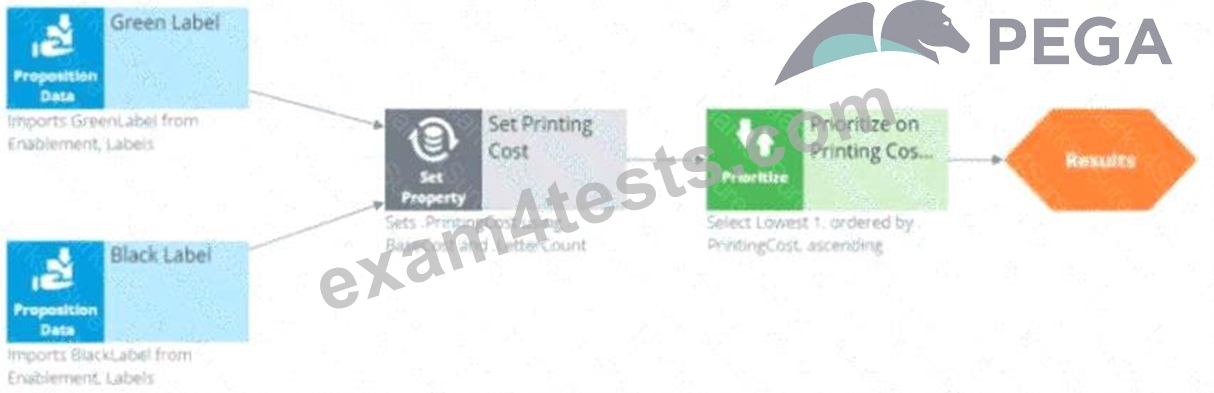
- A. To calculate the printing cost for each of the actions.
- B. To filter actions based on the printing cost.
- C. To import the printing cost property into the strategy.
- D. To create a new strategy property.
Answer: A
NEW QUESTION # 61
You are a deaccessioning architect on a next-best-action project and are responsible for designing and implementing decision strategies. Select each component on the left and drag it to the correct requirement on the right.
Answer:
Explanation:
A close-up of a list of words AI-generated content may be incorrect.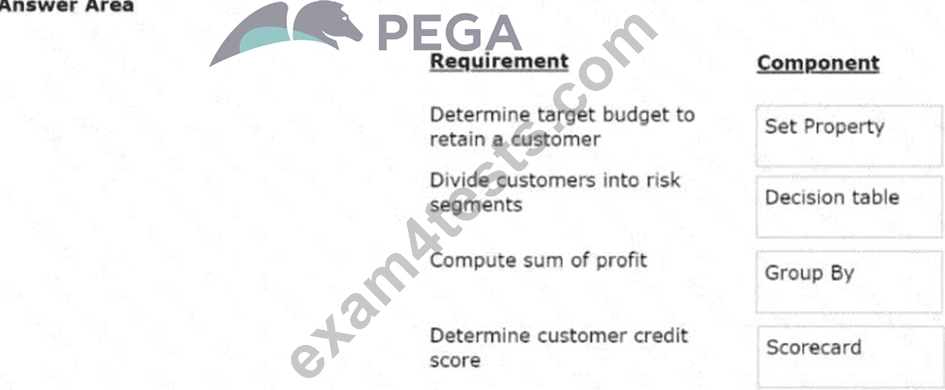
NEW QUESTION # 62
......
Achive your Success with Latest Pegasystems PEGACPDC25V1 Exam: https://exam-labs.exam4tests.com/PEGACPDC25V1-pdf-braindumps.html