

Get Apr-2026 updated Exam NSE7_OTS-7.2 Dumps with New Questions
100% Pass Guarantee for NSE7_OTS-7.2 Exam Dumps with Actual Exam Questions
NEW QUESTION # 20
FortiAnalyzer is implemented in the OT network to receive logs from responsible FortiGate devices. The logs must be processed by FortiAnalyzer.
In this scenario, which statement is correct about the purpose of FortiAnalyzer receiving and processing multiple log messages from a given PLC or RTU?
- A. To help OT administrators configure the network and prevent breaches
- B. To determine which type of messages from the PLC or RTU causes issues in the plant
- C. To isolate PLCs or RTUs in the event of external attacks
- D. To configure event handlers and take further action on FortiGate
Answer: B
Explanation:
FortiAnalyzer acts as a centralized log management and analytics platform that collects security and operational logs from devices like FortiGate and from OT devices such as PLCs and RTUs.
By processing multiple log messages, FortiAnalyzer helps identify which specific types of messages or events from PLCs or RTUs may cause failures, anomalies, or operational issues in the plant.
This detailed insight into device behavior aids OT administrators in pinpointing communication or security issues affecting operational technology.
FortiAnalyzer provides aggregated analysis, threat detection, compliance reporting, and detailed root cause analytics relevant to OT environments.
NEW QUESTION # 21
Which two frameworks are common to secure ICS industrial processes, including SCADA and DCS? (Choose two.)
- A. IEC 62443
- B. Modbus
- C. NIST Cybersecurity
- D. IEC 104
Answer: A,C
Explanation:
NIST Cybersecurity Framework
This framework provides a comprehensive approach to managing cybersecurity risk across an organization, including industrial control systems. It offers a structured methodology for identifying, assessing, prioritizing, and responding to cyber threats.
IEC 62443
This standard specifically addresses cybersecurity for industrial automation and control systems (IACS). It provides detailed guidance on securing various aspects of ICS, from network segmentation to secure communication protocols.
NEW QUESTION # 22
An OT supervisor has configured LDAP and FSSO for the authentication. The goal is that all the users be authenticated against passive authentication first and, if passive authentication is not successful, then users should be challenged with active authentication.
What should the OT supervisor do to achieve this on FortiGate?
- A. Configure a firewall policy with LDAP users and place it on the top of list of firewall policies.
- B. Under config user settings configure set auth-on-demand implicit.
- C. Configure a firewall policy with FSSO users and place it on the top of list of firewall policies.
- D. Enable two-factor authentication with FSSO.
Answer: C
Explanation:
Explanation
The OT supervisor should configure a firewall policy with FSSO users and place it on the top of list of firewall policies in order to achieve the goal of authenticating users against passive authentication first and, if passive authentication is not successful, then challenging them with active authentication.
NEW QUESTION # 23
Refer to the exhibit.
An OT architect has implemented a Modbus TCP with a simulation server Conpot to identify and control the Modus traffic in the OT network. The FortiGate-Edge device is configured with a software switch interface ssw-01.
Based on the topology shown in the exhibit, which two statements about the successful simulation of traffic between client and server are true? (Choose two.)
- A. The FortiGate devices is in offline IDS mode.
- B. Port5 is not a member of the software switch.
- C. The FortiGate-Edge device must be in NAT mode.
- D. NAT is disabled in the FortiGate firewall policy from port3 to ssw-01.
Answer: C,D
NEW QUESTION # 24
An OT administrator configured and ran a default application risk and control report in FortiAnalyzer to learn more about the key application crossing the network. However, the report output is empty despite the fact that some related real-time and historical logs are visible in the FortiAnalyzer.
What are two possible reasons why the report output was empty? (Choose two.)
- A. The administrator selected the wrong time period for the report.
- B. The administrator selected the wrong devices in the Devices section.
- C. The administrator selected the wrong logs to be indexed in FortiAnalyzer.
- D. The administrator selected the wrong hcache table for the report.
Answer: A,B
Explanation:
https://fortinetweb.s3.amazonaws.com/docs.fortinet.com/v2/attachments/32cb817d-a307-11eb-b70b-0050569258
NEW QUESTION # 25
Refer to the exhibit.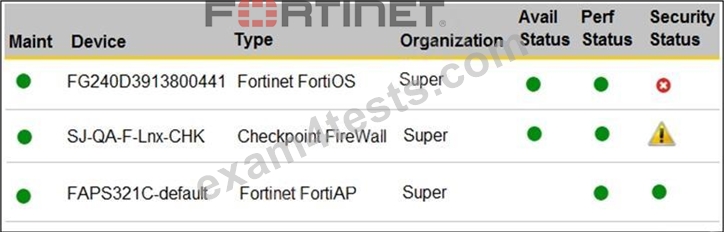
You are navigating through FortiSIEM in an OT network.
How do you view information presented in the exhibit and what does the FortiGate device security status tell you?
- A. In the PCI logging dashboard and there are one or more high-severity security incidents for the FortiGate device.
- B. In the business service dashboard and there are one or more high-severity security incidents for the FortiGate device.
- C. In the widget dashboard and there are one or more high-severity incidents for the FortiGate device.
- D. In the summary dashboard and there are one or more high-severity security incidents for the FortiGate device.
Answer: D
NEW QUESTION # 26
An OT network architect must deploy a solution to protect fuel pumps in an industrial remote network. All the fuel pumps must be closely monitored from the corporate network for any temperature fluctuations.
How can the OT network architect achieve this goal?
- A. Configure both fuel server and FortiSIEM with a single-pattern temperature performance rule on the corporate network.
- B. Configure a fuel server on the remote network, and deploy a FortiSIEM with a single pattern temperature security rule on the corporate network.
- C. Configure a fuel server on the remote network, and deploy a FortiSIEM with a single pattern temperature performance rule on the corporate network.
- D. Configure a fuel server on the corporate network, and deploy a FortiSIEM with a single pattern temperature performance rule on the remote network.
Answer: C
Explanation:
This way, FortiSIEM can discover and monitor everything attached to the remote network and provide security visibility to the corporate network
NEW QUESTION # 27
What is the primary objective of implementing SD-WAN in operational technology (OT) networks?
- A. Reduce security risk and threat attacks
- B. Enhance network performance of OT applications
- C. Replace standard links with lower cost connections
- D. Remove centralized network security policies.
Answer: B
Explanation:
The primary objective of implementing SD-WAN in operational technology (OT) networks is to enhance the performance and reliability of OT applications. SD-WAN optimizes traffic routing based on application requirements, network conditions, and business priorities, ensuring low latency and high availability for critical OT applications. This is essential in OT environments, where the performance of applications directly impacts operational efficiency and safety.
NEW QUESTION # 28
Refer to the exhibit.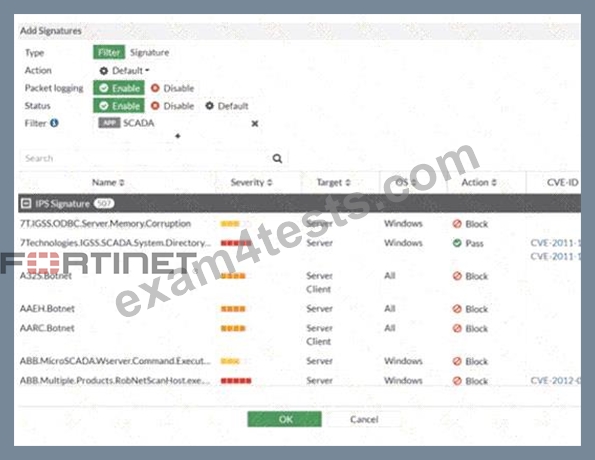
The IPS profile is added on all of the security policies on FortiGate.
For an OT network, which statement of the IPS profile is true?
- A. All IPS signatures are overridden and must block traffic match signature patterns.
- B. The IPS profile inspects only traffic originating from SCADA equipment.
- C. FortiGate has no IPS industrial signature database enabled.
- D. The listed IPS signatures are classified as SCADA equipment.
Answer: D
NEW QUESTION # 29
As an OT network administrator you are managing three FortiGate devices that each protect different levels on the Purdue model To increase traffic visibility you are required to implement additional security measures to detect protocols from PLCs Which security sensor must you implement to detect protocols on the OT network?
- A. Application control (AC)
- B. Deep packet inspection (DPI)
- C. Intrusion prevention system (IPS)
- D. Endpoint Detection and Response (EDR)
Answer: A
NEW QUESTION # 30
Refer to the exhibit, which shows a nonprotected OT environment. An administrator needs to implement appropriate protection on the OT network.
Which three steps should an administrator take to protect the OT network? (Choose three.)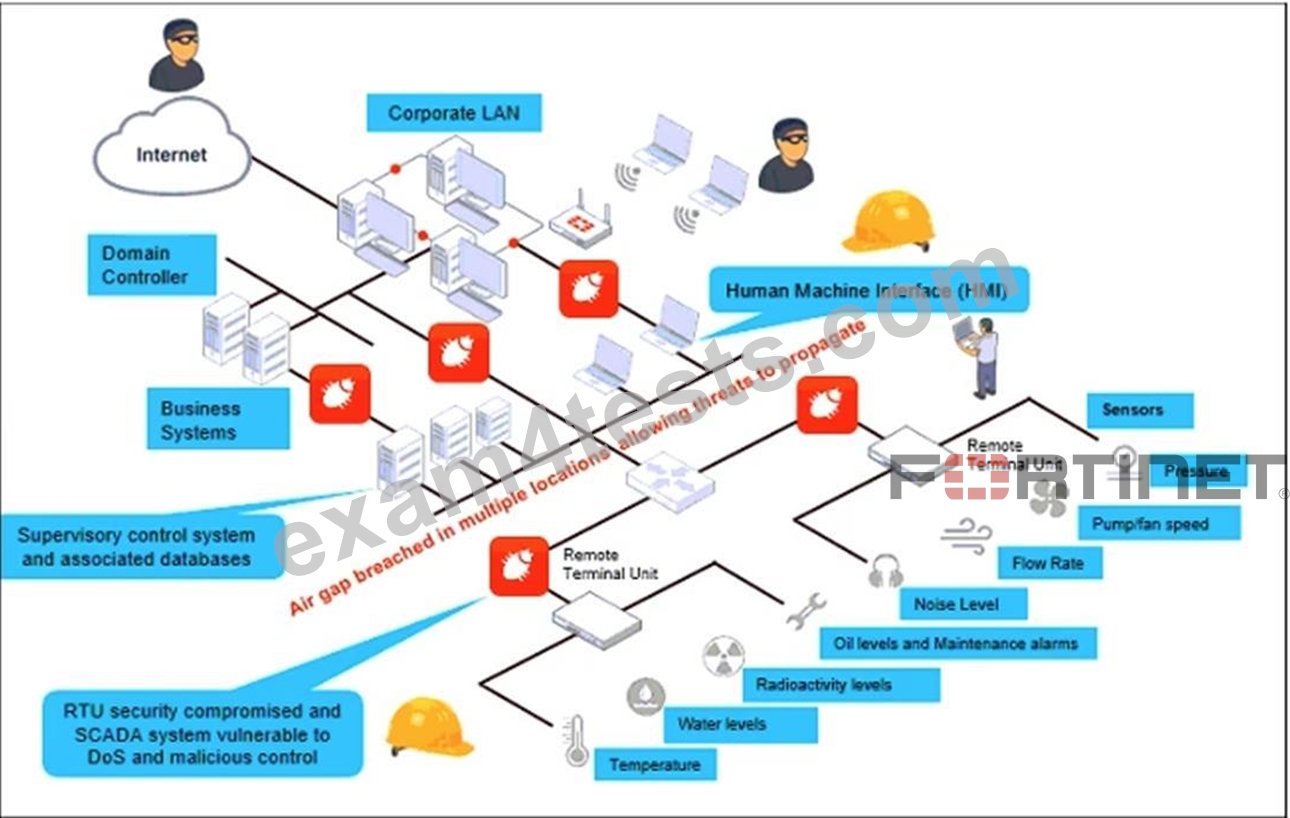
- A. Configure firewall policies with web filtering to protect the different ICS networks.
- B. Configure firewall policies with industrial protocol sensors.
- C. Deploy an edge FortiGate between the internet and the OT network as a one-arm sniffer.
- D. Deploy a FortiGate device within each ICS network.
- E. Use segmentation.
Answer: B,D,E
Explanation:
Use segmentation: Network segmentation is critical in an OT environment to isolate different ICS (Industrial Control System) networks and protect sensitive systems. This limits the spread of threats and provides controlled access between segments.
Deploy a FortiGate device within each ICS network: Deploying FortiGate devices in each ICS network ensures that localized security measures are in place to detect and prevent unauthorized access or threats.
Configure firewall policies with industrial protocol sensors: Configuring policies with industrial protocol sensors helps monitor and protect OT-specific traffic (e.g., Modbus, DNP3).
This enables the FortiGate to detect and respond to malicious activities targeting OT protocols.
NEW QUESTION # 31
Refer to the exhibit. An OT administrator ran a report to identify device inventory in an OT network.
Based on the report results, which report was run?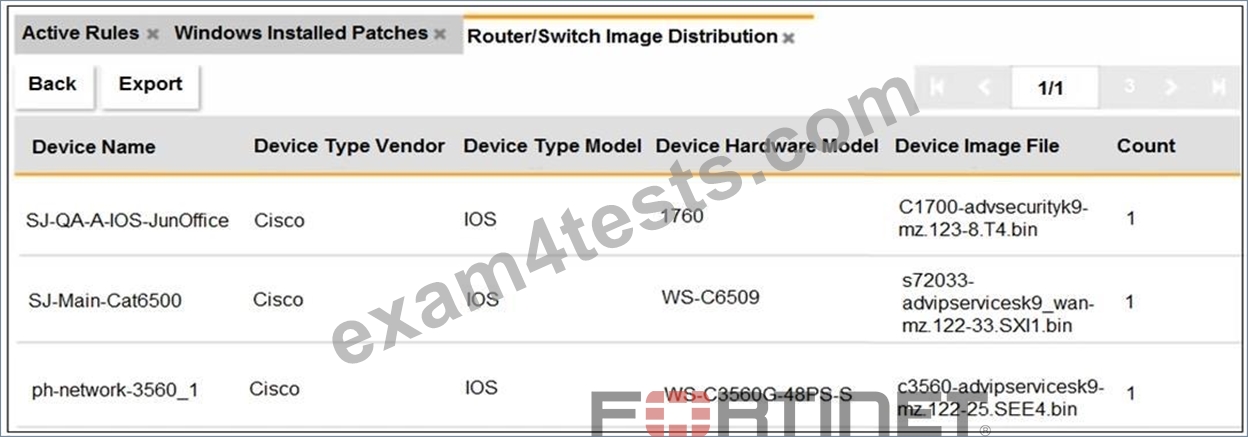
- A. A FortiSIEM analytics report
- B. A FortiAnalyzer device report
- C. A FortiSIEM incident report
- D. A FortiSIEM CMDB report
Answer: D
NEW QUESTION # 32
An OT architect has deployed a Layer 2 switch in the OT network at Level 1 the Purdue model-process control. The purpose of the Layer 2 switch is to segment traffic between PLC1 and PLC2 with two VLANs.
All the traffic between PLC1 and PLC2 must first flow through the Layer 2 switch and then through the FortiGate device in the Level 2 supervisory control network.
What statement about the traffic between PLC1 and PLC2 is true?
- A. The Layer 2 switches routes any traffic to the FortiGate device through an Ethernet link.
- B. In order to communicate, PLC1 must be in the same VLAN as PLC2.
- C. PLC1 and PLC2 traffic must flow through the Layer-2 switch trunk link to the FortiGate device.
- D. The Layer 2 switch rewrites VLAN tags before sending traffic to the FortiGate device.
Answer: C
Explanation:
Explanation
The statement that is true about the traffic between PLC1 and PLC2 is that PLC1 and PLC2 traffic must flow through the Layer-2 switch trunk link to the FortiGate device.
NEW QUESTION # 33
Which deployment option allows an administrator to detect intrusions without any modifications to production traffic?
- A. Offline IPS
- B. Virtual patching
- C. Inline IPS and IDS
- D. Offline IDS
Answer: D
NEW QUESTION # 34
Refer to the exhibit. The network topology in the exhibit shows FortiGate devices as well as FortiAnalyzer and FortiSIEM for the OT network.
Which two steps must you take to configure logging on the OT network'? (Choose two.)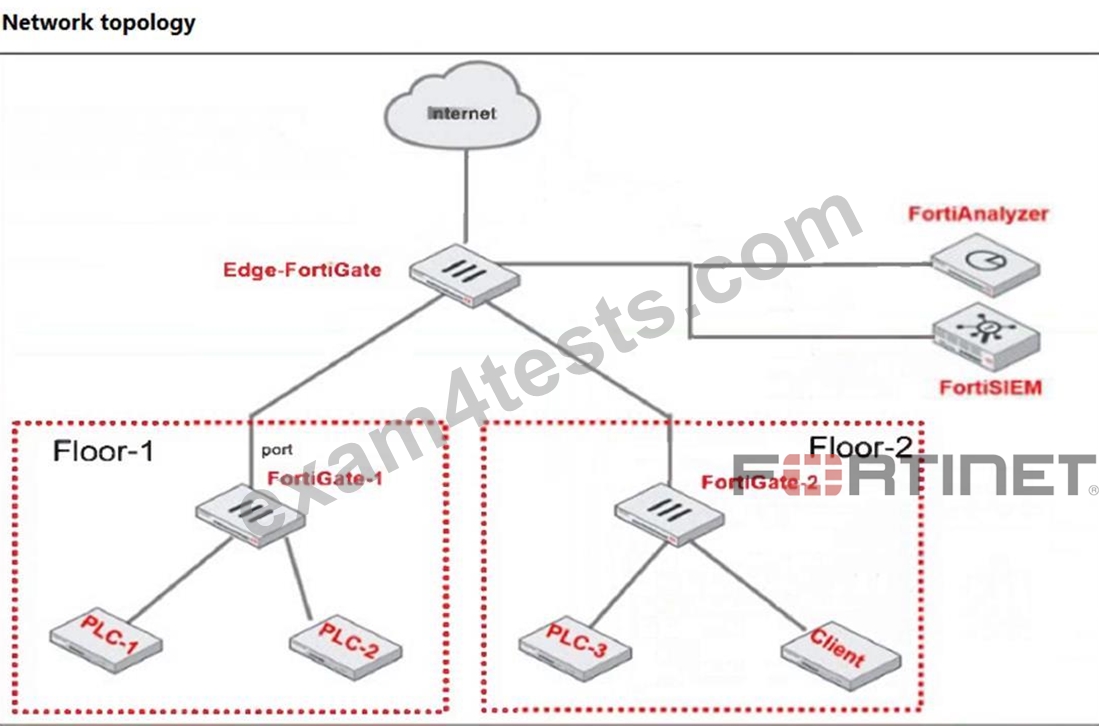
- A. Configure FortiAnalyzer to send security events to FortiSIEM.
- B. Configure FortiGate and FortiAnalyzer to send industrial signature patterns to FortiSIEM.
- C. Configure FortiGate to send logs to FortiAnalyzer and FortiSIEM.
- D. Configure FortiSIEM to send logs and alerts to FortiAnalyzer.
Answer: A,C
Explanation:
FortiGates must forward their logs directly to both FortiAnalyzer and FortiSIEM for storage and correlation. FortiAnalyzer then forwards relevant security events to FortiSIEM, enabling centralized analytics across OT devices.
NEW QUESTION # 35
Which three Fortinet products can you use for device identification in an OT industrial control system (ICS)? (Choose three.)
- A. FortiSIEM
- B. FortiManager
- C. FortiAnalyzer
- D. FortiGate
- E. FortiNAC
Answer: A,D,E
NEW QUESTION # 36
......
NSE7_OTS-7.2 exam dumps with real Fortinet questions and answers: https://exam-labs.exam4tests.com/NSE7_OTS-7.2-pdf-braindumps.html