

[Aug 17, 2026] Verified Integration-Architect dumps and 130 unique questions
Integration-Architect Dumps for Pass Guaranteed - Pass Integration-Architect Exam 2026
NEW QUESTION # 46
Universal Containers (UC) uses Salesforce Service Cloud. Support agents open bank accounts on the spot.
UC's core banking system is the system of record, and all accounts opened in Salesforce must be synced in real time. Agents need to inform the customers of the newly created bank account ID, which is generated by the core banking system. Which integration pattern is recommended for this use case?
- A. Request and Reply
- B. Salesforce platform event
- C. Streaming API to generate PushTopic
Answer: A
Explanation:
The requirement for an agent to receive a newly created bank account ID in real time to inform a customer signifies a synchronous dependency. The agent cannot complete the business process until the core banking system confirms the account creation and returns the generated identifier.
The Request and Reply pattern is the appropriate recommendation for this use case. In this pattern:
* Request: Salesforce sends a synchronous callout (REST or SOAP) containing the customer's data to the core banking system.
* Wait: The Salesforce thread remains open, and the user interface typically displays a loading indicator while waiting for the external system to process the request.
* Reply: The core banking system returns the new account ID, which is then immediately displayed to the support agent in Salesforce.
Options A (Platform Events) and C (Streaming API) are asynchronous, event-driven patterns. While highly scalable, they are unsuitable for this specific "on the spot" requirement because there is no native way to force the agent's screen to wait for an asynchronous callback with the new ID. Request and Reply ensures that the agent has the necessary information to complete the customer interaction in a single, continuous flow.
NEW QUESTION # 47
A new Salesforce program has the following high-level abstract requirement: Business processes executed on Salesforce require data updates between their internal systems and Salesforce. Which relevant detail should an integration architect seek to specifically solve for integration architecture needs of the program?
- A. Timing aspects, real-time/near real-time (synchronous or asynchronous), batch and update frequency
- B. Integration skills, SME availability, and Program Governance details
- C. Core functional and non-functional requirements for User Experience design, Encryption needs, Community, and license choices
Answer: A
Explanation:
In the discovery and translation phase of a Salesforce project, an Integration Architect must move beyond high-level business goals to define the technical "DNA" of the data exchange. While organizational readiness and user experience are vital to project success, they do not dictate the architectural patterns required to move data between systems.
The most critical details for designing an integration architecture are the Timing and Volume requirements.
Identifying whether a business process is Synchronous or Asynchronous is the primary decision point. For example, if a Salesforce user requires an immediate validation from an external system before they can save a record, a synchronous "Request-Reply" pattern using an Apex Callout is required. If the data update can happen in the background without blocking the user, an asynchronous "Fire-and-Forget" pattern is preferred to improve system performance and user experience.
Furthermore, understanding the Update Frequency (e.g., real-time, hourly, or nightly) and the Data Volume (e.g., 100 records vs. 1 million records) allows the architect to select the appropriate Salesforce API. High- volume, low-frequency updates are best handled by the Bulk API to minimize API limit consumption, while low-volume, high-frequency updates are better suited for the REST API or Streaming API. By specifically seeking out these timing and frequency aspects, the architect ensures that the chosen solution is scalable, stays within platform governor limits, and meets the business's Service Level Agreements (SLAs). Without these details, the architect risks designing a solution that is either too slow for the business needs or too taxing on system resources.
NEW QUESTION # 48
Northern Trail Outfitters (NTO) use Salesforce to track leads, opportunities, and to capture order details. However, Salesforce isn't the system that holds or processes orders. After the order details are captured in Salesforce, an order must be created in the remote system, which manages the orders lifecylce. The Integration Architect for the project is recommending a remote system that will subscribe to the platform event defined in Salesforce.
Which integration pattern should be used for this business use case?
- A. Fire and Forget
- B. Batch Data Synchronization
- C. Request and Reply
- D. Remote Call In
Answer: A
NEW QUESTION # 49
A business requires automating the check and updating of the phone number type classification for all incoming calls. Up to 100,000 calls per day are received, and the business is flexible with timing (every 6-12 hours is sufficient). A Remote-Call-In and/or Batch Synchronization pattern via middleware is planned.
Which component should an integration architect recommend to implement these patterns?
- A. Remote Site Settings configured in Salesforce to authenticate the middleware
- B. An API Gateway that authenticates requests from Salesforce into the middleware (ETL/ESB)
- C. Connected App configured in Salesforce to authenticate the middleware
Answer: C
Explanation:
In a Remote-Call-In or Batch Synchronization pattern where an external middleware initiates the connection to Salesforce, the external system must be authenticated. The standard Salesforce framework for this is the Connected App.
A Connected App provides a framework for external applications to integrate with Salesforce using APIs and standard protocols like OAuth 2.0. For a high-volume (100,000 records) batch process initiated by middleware every 6-12 hours, the architect would recommend a Connected App using a secure flow, such as the OAuth 2.0 JWT Bearer Flow. This allows the middleware to authenticate as a specific "Integration User" without storing clear-text passwords.
Option A (API Gateway) is used to manage and secure outbound calls from Salesforce or between external services; it does not handle inbound authentication to the Salesforce org itself. Option B (Remote Site Settings) is a whitelist configuration used purely to allow Salesforce to make outbound callouts to a specific URL; it provides no authentication mechanism for systems calling into Salesforce. By recommending a Connected App, the architect ensures that the middleware has the necessary permissions (scopes) to use the Bulk API-which is the appropriate mechanism for the 100,000 record volume-while maintaining a secure, auditable, and standard integration boundary.
NEW QUESTION # 50
Northern Trail Outfitters wants to improve the quality of call-outs from Salesforce to their REST APIs. For this purpose, they will require all API clients/consumers to adhere to RESTAPI Markup Language (RAML) specifications that include field-level definition of every API request and response payload. RAML specs serve as interface contracts that Apex REST API Clients can rely on.
Which two design specifications should the Integration Architect include in the integration architecture to ensure that Apex REST API Clients unit tests confirm adherence to the RAML specs?
Choose 2 answers
- A. Require the Apex REST API Clients to implement the HttpCalloutMock.
- B. Call the Apex REST API Clients in a test context to get the mock response.
- C. Implement HttpCalloutMock to return responses per RAML specification.
- D. Call the HttpCalloutMock implementation from the Apex REST API Clients.
Answer: B,C
NEW QUESTION # 51
Northern Trail Outfitters requires an integration to be set up between one of its Salesforce orgs and an External Data Source using Salesforce Connect. The External Data Source supports Open Data Protocol.
Which configuration should an integration architect recommend be implemented in order to secure requests coming from Salesforce?
- A. Configure CSRF Protection for OData connection.
- B. Configure Identity Type for OData connection.
- C. Configure Special Compatibility for OData connection.
Answer: B
Explanation:
In the context of Salesforce Connect, securing the integration depends heavily on how the platform authenticates with the external system. The Identity Type configuration is the fundamental security setting for an External Data Source.
The architect must choose between two Identity Types:
* Named Principal: Salesforce uses the same set of credentials for all users to access the external system. This is simple to manage but does not allow the external system to distinguish between individual Salesforce users for auditing or permission purposes.
* Per User: Each Salesforce user must have their own credentials for the external system. This is the most secure option as it ensures that the data visible in Salesforce respects the specific permissions the user has in the source system.
By correctly configuring the Identity Type, the architect ensures that the requests coming from Salesforce are properly authorized at the target system. Option B (CSRF Protection) is a security measure to prevent cross- site request forgery but is not the primary mechanism for authenticating the Salesforce service itself. Option A is a technical compatibility setting for non-standard OData implementations and does not directly relate to security. Therefore, recommending the appropriate Identity Type-typically "Per User" for sensitive data-is the key step in securing the OData connection.
NEW QUESTION # 52
Northern Trail Outfitters is in the final stages of merging two Salesforce orgs but needs to keep the retiring org available for a short period of time for lead management as it is connected to multiple public web site forms.
The sales department has requested that new leads are available in the new Salesforce instance within 30 minutes.
Which two approaches will require the least amount of development effort?
Choose 2 answers
- A. Use the tooling API with Process Builder to insert leads in real time.
- B. Configure named credentials in the source org.
- C. Use the Composite REST API to aggregate multiple leads in a single call.
- D. Call the Salesforce REST API to insert the lead into the target system.
Answer: B,C
Explanation:
The two approaches that will require the least amount of development effort are configuring named credentials in the source org and using the Composite REST API to aggregate multiple leads in a single call.
Named credentials are a type of metadata that store authentication information for accessing external services, such as the target Salesforce org. By using named credentials, you can simplify the code for making callouts and avoid hardcoding credentials or tokens.
The Composite REST API is a resource that allows you to execute multiple REST API requests in a single call.
You can use the Composite REST API to create, update, or delete up to 25 records in one request.
This can reduce the number of API calls and improve performance.
References: [Named Credentials], [Composite Resources]
NEW QUESTION # 53
Universal learning (UC) is embarked on Salesforce transformation journey, UC will decommission the legacy CRM system and migrate data to Salesforce. The data migration team asked for a recommendation to optimize the performance of the data load to Salesforce.
Which approach should used to meet the requirement?
- A. Use Bulk API to process jobs in serial mode.
- B. Use Bulk API to process jobs in parallel mode.
- C. Contact Salesforce support to schedule performance load.
- D. Use Bulk API to process jobs in high performance mode.
Answer: B
NEW QUESTION # 54
NorthernTrail Outfitters needs to send order and line items directly to an existing finance application webservicewhen an order if fulfilled. It is critical that each order reach the finance application exactly once for accurate invoicing.
What solution should anarchitect propose?
- A. Outbound Messaging, which will automatically handle error retries to the service.
- B. Trigger invokes Queueable Apex method, with custom error handling process.
- C. Triggermakes @future Apex method, with custom error handling process.
- D. Button press invokes synchronous callout, with user handling retries in case of error
Answer: B
Explanation:
Trigger invokes Queueable Apex method, with custom error handling process. Queueable Apex allows you to run asynchronous jobs that can make callouts to external web services. You can use custom error handling logic to handle any failures and retry the callouts if necessary. You can also use Database.Stateful interface to maintain state across transactions and ensure that each order is sent exactly once. This solution meets the requirements of sending order and line items directly to an existing finance application web service when an order is fulfilled, and ensuring that each order reaches the finance application exactly once for accurate invoicing. References: Certification - Integration Architect - Trailhead, [Queueable Apex], [Making a Web Service Callout from a Queueable Apex Job]
NEW QUESTION # 55
A company that is a leading provider of courses and training delivers courses using third party trainers. The trainer for the company has to be verified from 10 different training accreditation verification agencies before providing training for the company. Each training accreditation agency has its own response time, which could take days to confirm a trainer.
The company decided to automate the trainer accreditation verification process by integrating to the agencies' web services.
What is the recommended approach to automate this process?
- A. Use salesforce external service to make the call out, Salesforce external service should check the verification agencies until the result is verified, then update the trainer status to "verified".
- B. Make an apex callout using @future annotation to make the call out to all different agencies. The response should update the trainer status to "verified".
- C. Create a trigger on the trainer record to make a Callout to each verification agencies, write business logic to consolidate the verification then update the trainer status to verified".
- D. Use middleware to handle the call out to the 10 different verification services, the middleware will handle the business logic of consolidating the verification result from t 10 services, then make a call-in to salesforce and update the verification status to "verified".
Answer: D
Explanation:
Explanation
Answer D is valid because using middleware to handle the call out to the 10 different verification services is a scalable and reliable solution that can handle the complexity and variability of the integration. The middleware can orchestrate the calls to the different web services, consolidate the verification results, and handle any errors or retries. The middleware can then make a call-in to Salesforce and update the verification status to "verified" using an API or a platform event12 Answer A is not valid because using Salesforce external service to make the call out to the 10 different verification services is not a feasible or efficient solution. Salesforce external service is a feature that allows invoking an external service from a flow and mapping its inputs and outputs to flow variables.
However, this feature requires configuring an Apex action, a named credential, and an external service definition for each web service, which is not a low code solution. Moreover, this feature does not support checking the verification agencies until the result is verified, as it only invokes the external service once per flow interview3 Answer B is not valid because creating a trigger on the trainer record to make a callout to each verification agency is not a recommended or robust solution. Triggers are Apex code that execute before or after database events, such as insert, update, or delete. However, triggers cannot make callouts directly, as they are part of a database transaction and must complete quickly. To make a callout from a trigger, an asynchronous process such as a future method or a queueable job must be used, which adds complexity and overhead to the integration. Moreover, triggers have limits on the number of callouts and asynchronous calls they can make per transaction, which may affect the scalability and reliability of the integration.
Answer C is not valid because making an Apex callout using @future annotation to make the call out to all different agencies is not a suitable or reliable solution. The @future annotation allows marking a method for execution at a later time when system resources become available. However, this annotation has several limitations and drawbacks, such as:
Future methods cannot return values, so they cannot update the trainer status to "verified" directly.
Future methods have limits on the number of callouts and future calls they can make per execution, which may affect the scalability and reliability of the integration.
Future methods run in their own thread and do not share any static variables or state with other methods, which makes it difficult to consolidate the verification results from different agencies.
Future methods are not guaranteed to execute at a specific time or order, which may affect the timeliness and accuracy of the integration.
1: Orchestration Pattern 2: Remote Process Invocation-Request and Reply 3: External Services : Apex Developer Guide: Triggers : Apex Developer Guide: Using Future Methods
NEW QUESTION # 56
Northern Trail Outfitters' ERP is integrated with Salesforce and syncs several million contacts per day.
Toprevent specific data from syncing, the integration uses a SOQL query filtered by sharing hierarchy.
Which two things should an architect do to improve the performance of the integration?
Choose 2 answers
- A. Include non-selective criteria in query filters.
- B. Include selective criteria in query filters.
- C. Remove the sharing restrictions.
- D. Remove the query filters.
Answer: B,C
Explanation:
Option C is correct because including selective criteria in query filters can improve the performance of the integration. Selective criteria are filters that reduce the number of records that need to be scanned by the query optimizer, such as indexed fields, standard indexes, or custom indexes. Selective criteria can help the query run faster and avoid hitting the query timeout limit or the query row limit.
Option D is correct because removing the sharing restrictions can improve the performance of the integration.
Sharing restrictions are filters that limit the access to records based on the user's role, profile, or sharing rules.
Sharing restrictions can add complexity and overhead to the query execution, as they require additional joins and calculations. Removing the sharing restrictions can simplify the query and reduce the number of records that need to be processed.
Option A is incorrect because including non-selective criteria in query filters can degrade the performance of the integration. Non-selective criteria are filters that do not reduce the number of records that need to be scanned by the query optimizer, such as non-indexed fields, formula fields, or OR conditions. Non-selective criteria can cause the query to run slower and hit the query timeout limit or the query row limit.
Option B is incorrect because removing the query filters can degrade the performance of the integration.
Query filters are conditions that specify which records to retrieve from the database, such as WHERE clauses or LIMIT clauses. Query filters can help the query run faster and avoid retrieving unnecessary or unwanted data. Removing the query filters can increase the number of records that need to be processed and transmitted by the integration.
References: Working with Very Large SOQL Queries: Improve performance with custom indexes using Salesforce Query Plan tool: Querying Data That Respects UserPermissions: How does sharing affect SOQL performance?: SOQL SELECT Syntax : SOQL Best Practices
NEW QUESTION # 57
An integration architect needs to build a solution that will be using the Streaming API, but the data loss should be minimized, even when the client re-connects every couple of days.
Which two types of Streaming API events should be considered?
Choose 2 answers
- A. PushTopic Events
- B. Generic Events
- C. High Volume Platform Events
- D. Change Data Capture Events
Answer: C,D
Explanation:
Explanation
The integration architect should consider Change Data Capture Events and High Volume Platform Events for using the Streaming API with minimal data loss. Change Data Capture Events capture changes to Salesforce records and deliver them as events to subscribers. High Volume Platform Events are custom events that can be published and consumed at a large scale. Both types of events support reliable event delivery, which means that events are stored for 72 hours and can be replayed by subscribers in case of connection loss or failure. This ensures that data loss is minimized, even when the client re-connects every couple of days12 References: Change Data Capture Developer Guide, Platform Events Developer Guide
NEW QUESTION # 58
Which two approaches will require the least amount of development effort?
Choose 2 answers
- A. Use the tooling API with Process Builder to insert leads in real time.
- B. Configure named credentials in the source org.
- C. Use the Composite REST API to aggregate multiple leads in a single call.
- D. Call the Salesforce REST API to insert the lead into the target system.
Answer: B,C
Explanation:
The two approaches that will require the least amount of development effort are configuring named credentials in the source org and using the Composite REST API to aggregate multiple leads in a single call. Named credentials are a type of metadata that store authentication information for accessing external services, such as the target Salesforce org. By using named credentials, you can simplify the code for making callouts and avoid hardcoding credentials or tokens. The Composite REST API is a resource that allows you to execute multiple REST API requests in a single call. You can use the Composite REST API to create, update, or delete up to 25 records in one request. This can reduce the number of API calls and improve performance.
References: [Named Credentials], [Composite Resources]
NEW QUESTION # 59
Northern Trail Outfitters needs a low-code, near real-time REST integration to an ERP when an Order is created. They have limited development resources. Which option should fulfill the use case requirements?
- A. Use Lightning Flow to create a platform event, selecting the record type as the platform event name on insert of record.
- B. Implement Change Data Capture on the Order object and leverage the replay ID in the middleware solution.
- C. Implement a Workflow Rule with Outbound Messaging to send SOAP messages to the designated endpoint.
Answer: A
Explanation:
For a team with limited development resources and a low-code requirement, Lightning Flow (Flow Builder) is the primary declarative engine for modern integrations.
In this scenario, creating a Platform Event via a record-triggered flow provides a highly scalable, near real- time "Fire-and-Forget" signal to the middleware. This is considered low-code because it can be built entirely using point-and-click tools within Salesforce. Once the Order is created, the flow publishes the event to the bus. The middleware, acting as a subscriber, receives the event and orchestrates the REST call to the ERP.
Option C (Outbound Messaging) is also a low-code tool, but it natively sends messages in SOAP format.
Since the ERP requires a REST endpoint, using Outbound Messaging would necessitate additional transformation logic in the middleware, making it a less efficient architectural choice than using a Flow to trigger an event or an External Service. Option B (Change Data Capture) is a powerful tool but often requires more advanced "pro-code" configuration on the subscriber/middleware side to handle Replay IDs and Bayeux protocols, which might exceed the "limited resources" constraint of the Salesforce team.
NEW QUESTION # 60
Northern Trail Outfitters (NTO) uses a custom mobile app to interact with their customers.
One of the features of the app are Salesforce Chatter Feeds. NTO wants to automatically post a Chatter item to Twitter whenever the post includes the #thanksNTO hashtag.
Which API should an Integration Architect use to meet this requirement?
- A. Connect REST API
- B. REST API
- C. Streaming API
- D. Apex REST
Answer: A
NEW QUESTION # 61
Northern Trail Outfitters needs to use Shield Platform Encryption to encrypt social security numbers in order to meet a business requirement. Which action should an integration architect take prior to the implementation of Shield Platform Encryption?
- A. Encrypt the data using the most current key.
- B. Encrypt all the data so that it is secure.
- C. Review Shield Platform Encryption configurations and functional limitations.
Answer: C
Explanation:
Prior to implementing Shield Platform Encryption, the most critical step for an Integration Architect is to perform a comprehensive Review of Shield Platform Encryption configurations and their impact on existing platform functionality. Encryption at rest is not a "set-and-forget" feature; it changes how the Salesforce database interacts with various features, and failing to review these limitations beforehand can lead to significant business disruption.
Salesforce documentation emphasizes that encryption affects several core areas:
* SOQL/SOSL Limitations: Encrypted fields have restricted capabilities in WHERE, GROUP BY, and ORDER BY clauses.1 For example, if Social Security Numbers (SSNs) are encrypted using Probabilistic Encryption, they cannot be filtered or sorted in a query.2 This could break existing integrations or reports that rely on finding specific records by SSN.
* Search Functionality: While Salesforce supports searching for encrypted data, there are specific behaviors to consider regarding how search indexes are built and updated.
* AppExchange and Managed Packages: If the SSN field is used by a third-party app or a managed package, encrypting it might cause those external tools to fail if they are not designed to handle encrypted data types.
* Field Attributes: Encrypted fields cannot be used as Unique or External IDs if using the probabilistic scheme, which is a vital consideration for data synchronization architectures.3 Therefore, the architect must first conduct a Business Impact Analysis. This includes identifying where the sensitive data (SSNs) is used in Apex code, Flows, validation rules, and reports. By reviewing the configurations and functional limitations first, the architect can decide between Probabilistic (higher security) and Deterministic (allows filtering) encryption strategies.4 Option A is a step taken during or after implementation (Background Encryption), and Option C is an anti-pattern, as encrypting " everything" leads to unnecessary performance overhead and massive functional loss. Only after a thorough review can the architect safely proceed with the technical implementation of Shield.
NEW QUESTION # 62
Which two system constraint questions should be considered when designing an integration to send orders from Salesforce to a fulfillment system?
Choose 2 answers
- A. Which system will validate order shipping addresses?
- B. Can the fulfillment system implement a contract-first Outbound Messaging interface?
- C. Can the fulfillment system participate in idempotent design to avoid duplicate orders?
- D. What latency is acceptable for orders to reach the fulfillment system?
Answer: B,C
NEW QUESTION # 63
An Integration Architect has designed a mobile application for Salesforce users to get data while on the road using a custom UI. The application is securedwith oAuth and is currently functioning well. There is a new requirement where the mobile application needs to obtain the GPS coordinates and storeit on a custom geolocation field.
The geolocation field is secured with Field Level Security, so users can view the value without changing it.
What should be done to meet the requirement?
- A. The mobile device makes a REST API inbound call.
- B. The mobile device makes a SOAP API inbound call.The mobile device receives a REST Apex callout call.
- C. The mobile devicemakes a REST Apex inbound call.
Answer: C
Explanation:
The mobile device should make a REST Apex inbound call to meet the requirement. A REST Apex inbound call allows the mobile device to invoke custom Apex logic on Salesforce using a RESTful interface. The Apex logiccan then access the geolocation field using the user's OAuth token and update it with the GPS coordinates from the mobile device. The geolocation field is secured with Field Level Security, so the user can view the value without changing it. A SOAP API inbound call or a REST API inbound call would not be able to access the custom geolocation field, as they are not supported by the standard Salesforce objects and fields. Reference: Salesforce Integration Architecture Designer Resource Guide, page 20
NEW QUESTION # 64
A new Salesforce program has the following high level abstract requirement: Business processes executed on Salesforce require data updates between the internal systems and Salesforce Which three relevant details should a Salesforce Integration Architect seek to specifically solve for Integration architecture needs of the program?
Which three relevant details should a Salesforce Integration Architect seek to specifically solve for Integration architecture needs of the program?
Choose 3 answers
- A. Integration Style Process based, Data based, Virtual integration. E Core functional and non-functional requirements for User Experience design, Encryption needs, Community, and license choices.
- B. Integration skills, SME availability and Program Governance details.
- C. Timing aspects - real-time/near real-time (synchronous or asynchronous), batch; update frequency.
- D. Source and Target system, Directionality, data volume & transformation complexity long with any middleware that can be leveraged.
Answer: A,C,D
Explanation:
Explanation
The correct answer is A, C, and D. These are three relevant details that a Salesforce Integration Architect should seek to specifically solve for Integration architecture needs of the program. These details can help the Integration Architect to understand the scope, requirements, and constraints of the integration solution, and to choose the appropriate tools, methods, and patterns. The details are:
Source and Target system, Directionality, data volume & transformation complexity along with any middleware that can be leveraged. This detail can help the Integration Architect to identify the systems involved in the integration, the direction of data flow, the amount and complexity of data to be exchanged, and the middleware or platform capabilities that can facilitate the integration.
Timing aspects - real-time/near real-time (synchronous or asynchronous), batch; update frequency. This detail can help the Integration Architect to determine the latency, reliability, and scalability requirements of the integration solution, and to choose the suitable integration protocols and techniques.
Integration Style - Process based, Data based, Virtual integration. This detail can help the Integration Architect to select the appropriate integration style that matches the business needs and objectives.
Process based integration focuses on orchestrating business processes across systems, data based integration focuses on synchronizing data across systems, and virtual integration focuses on providing a unified view of data across systems.
References: Certification - Integration Architect - Trailhead, [Integration Patterns and Practices]
NEW QUESTION # 65
A company needs to integrate a legacy on premise application that can only support SOAP API. After the Integration Architect has evaluated the requirements and volume, they determined that the Fire and Forget integration pattern will be most appropriate for sending data from Salesforce to the external application and getting response back in a strongly typed format.
Which integration capabilities should be used to integrate the two systems?
- A. Outbound Message for Salesforce to Legacy System direction and SOAP API using Enterprise WSDL for the communication back from legacy system to salesforce.
- B. Outbound Message for Salesforce to Legacy System direction and SOAP API using Partner WSDL for the communication back from legacy system to salesforce.
- C. Platform Events for Salesforce to Legacy System direction and SOAP API using Partner WSDL for the communication back from legacy system to salesforce.
- D. Platform Events for Salesforce to Legacy System direction and SOAP API using Enterprise WSDL for the communication back from legacy system to salesforce.
Answer: A
Explanation:
Explanation
Outbound Message is a SOAP-based notification service that sends information about changes in Salesforce to a specified endpoint. It is a type of Remote Process Invocation-Fire and Forget integration pattern, which means that Salesforce does not wait for a response from the external system. Outbound Message can be configured using workflow rules or process builder, and it can include a subset of fields of the object that triggered the message. Outbound Message requires the external system to expose a SOAP web service that conforms to the WSDL generated by Salesforce1.
SOAP API is a way to access Salesforce data and functionality using SOAP (Simple Object Access Protocol), which is a standard XML-based protocol for exchanging structured data over the web. SOAP API can be used for both inbound and outbound integration, and it supports two types of WSDL (Web Service Description Language) files: Enterprise and Partner. Enterprise WSDL is a strongly typed WSDL file that is specific to an organization's Salesforce configuration. It can be used when the client application knows the objects and fields it needs to access at compile time. Partner WSDL is a loosely typed WSDL file that is generic for any organization. It can be used when the client application needs to access data dynamically at run time2.
Therefore, the correct answer is A, because Outbound Message is suitable for Fire and Forget integration from Salesforce to the legacy system, and SOAP API using Enterprise WSDL is suitable for getting response back in a strongly typed format from the legacy system to Salesforce.
References: 1: Remote Process Invocation-Fire and Forget | Integration Patterns and Practices | Salesforce Developers 2: SOAP API Developer Guide | SOAP API Basics | Salesforce Developers
NEW QUESTION # 66
A company's cloud-based single page application consolidates data local to the application with data from on- premise and Third-party systems. The diagram below typifies the application's combined use of synchronous and asynchronous calls. The company wants to use the average response time of its application's user interface as a basis for certain alerts. For this purpose, the following occurs:
* Log every call start and finish date and time to a central analytics data store.
* Compute response time uniformly as the difference between the start and finish date and time (A to H in the diagram).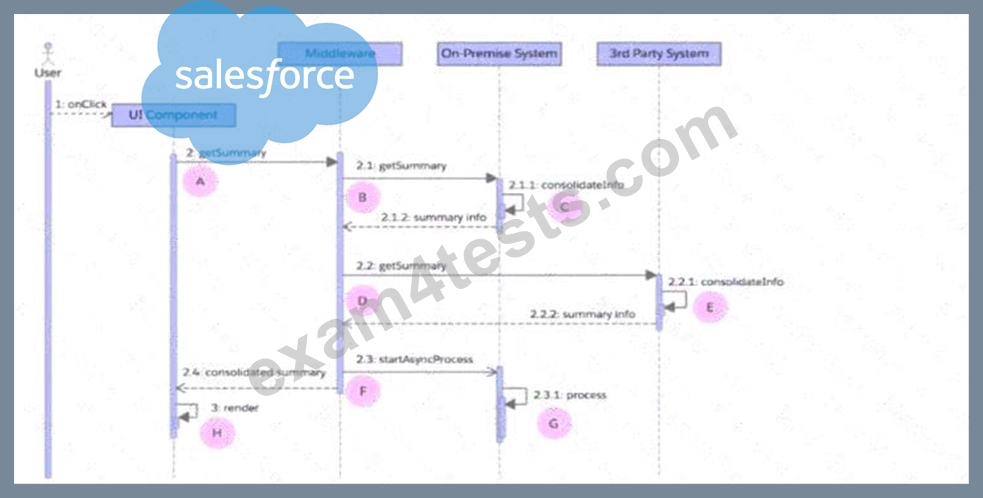
Which computation represents the end-to-end response time from the user's perspective?
- A. Sum of A to F
- B. Sum of A and H
- C. Sum of A to H
Answer: B
NEW QUESTION # 67
A new Salesforce program has the following high-level abstract requirement: Business processes executed on Salesforce require data updates between their Internal systems and Salesforce.
Which relevant detail should an integration architect seek to specifically solve for integration architecture needs of the program?
- A. Timing aspects, real-time/near real-time (synchronous or asynchronous), batch and update frequency
- B. Integration skills, SME availability, and Program Governance details
- C. Core functional and non-functionalrequirements for User Experience design, Encryption needs, Community and license choices
Answer: A
Explanation:
Timing aspects, real-time/near real-time (synchronous or asynchronous), batch and update frequency are relevant details that an integration architect should seek to specifically solve for integration architecture needs of the program. These details help to determine the appropriate integration pattern, technology, and solution for the business requirements. Core functional and non-functional requirements for User Experience design, Encryption needs, Community and license choices are important for the overall program design, but not specific to the integration architecture needs. Integration skills, SME availability, and Program Governance details are also important for the program execution, but not specific to the integration architectureneeds.
NEW QUESTION # 68
Universal containers are planning to implement Salesforce as their CRM system. Currently they have the following systems
1. Leads are managed in a Marketing System.
2. Sales people use Microsoft Outlook to enter contacts, emails and manage activities.
3. Inventory, Billing and Payments are managed in their ERP system. 4. The proposed CRM system is expected to provide Sales and Support people the ability to have a single view of their customers and manage their contacts, emails and activities in Salesforce CRM.
What should an Integration Consultant consider to support the proposed CRM system strategy?
- A. Evaluate current and future data and system usage and then identify potential integration requirements to Salesforce.
- B. Plan for migration of customer and sales data across systems on a regular basis to keep them in sync.
- C. Explore Out of box Salesforce connectors for integration with ERP, Marketing and Microsoft Outlook systems.
- D. Propose a middleware system that can support interface between systems with Salesforce.
Answer: A
Explanation:
Explanation
The integration consultant should evaluate current and future data and system usage and then identify potential integration requirements to Salesforce. This approach can help to understand the business needs, data flows, data quality, data volume, data frequency, and data security of the proposed CRM system. Based on this analysis, the integration consultant can design and implement the best integration solution for each system, such as Marketing, ERP, or Outlook.
References: [Salesforce Integration Architecture Designer Resource Guide]
NEW QUESTION # 69
A company is planning on sending orders from Salesforce to a fulfillment system. The integration architect has been asked to plan for the integration.
Which two questions should the integration architect consider?
Choose 2 answers
- A. Is the product catalog data identical at all times in both systems?
- B. Can the fulfillment system implement a contract-first Outbound Messaging interface?
- C. Can the fulfillment system create new addresses within the Order Create service?
- D. Can the fulfillment system make a callback into Salesforce?
Answer: B,D
Explanation:
https://www.youtube.com/watch?v=zQncznMLrt4 Contract first interface is important as it can impact integration design in terms of efficiency and collaboration.
NEW QUESTION # 70
Northern Trail Outfitters needs to make synchronous callouts "available to promise"services to query product availability and reserve inventory during customer checkout process.
Which two considerations should an integration architect make when building a scalable integration solution?
Choose 2 answers
- A. The maximum query cursors open per user on the service.
- B. The typical and worst-case historical response times.
- C. The number batch jobs that can run concurrently.
- D. How many concurrent service calls are being placed.
Answer: B,D
Explanation:
The typical and worst-case historical response times, and how many concurrent service calls are being placed are two considerations that an integration architect should makewhen building a scalable integration solution for synchronous callouts to "available to promise" services. These two factors can affect the performance, reliability, and availability of the integration solution, as well as the user experience of the customer checkout process. Theintegration architect should design the solution to handle high volumes of service calls, optimize the response times, handle errors and timeouts, and avoid hitting governor limits or service quotas.
References: Certification - Integration Architect - Trailhead, [Callout Limits and Limitations], [Integration Patterns and Practices]
NEW QUESTION # 71
......
Latest 100% Passing Guarantee - Brilliant Integration-Architect Exam Questions PDF: https://exam-labs.exam4tests.com/Integration-Architect-pdf-braindumps.html